Afraid of the Legal Mirror: Why Thailand Resists Binding International Law
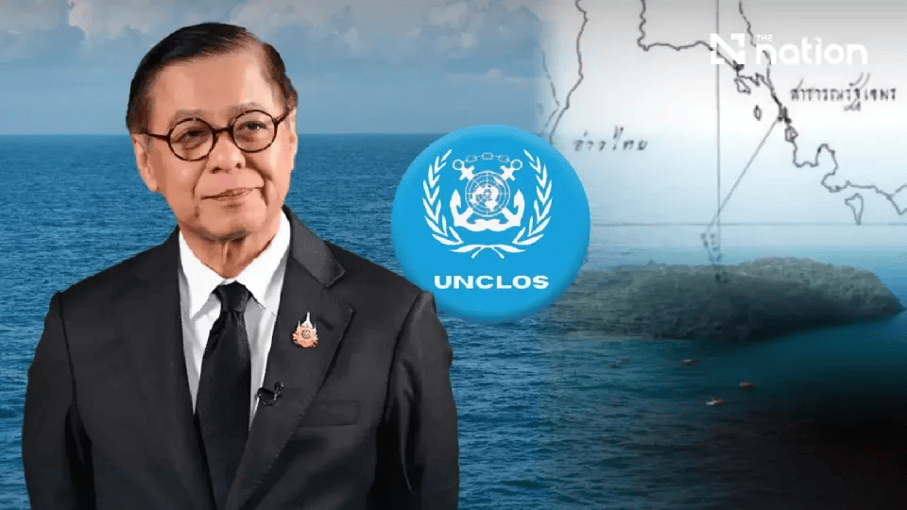
When Thai Foreign Minister Sihasak Phuangketkeow recently stressed that Thailand's UNCLOS conciliation with Cambodia in The Hague is non-binding and entirely separate from the International Court of Justice (ICJ), he was speaking mainly to anxious voters at home.
To the wider international community, however, the remark pointed to a familiar habit: Bangkok's ongoing reluctance to put its maritime and territorial claims under the close scrutiny of binding international law.
This wariness toward international courts is more than a simple preference for handling matters bilaterally. It reflects a basic weakness in legal strategy as well as the pressures of domestic politics.
Under international legal frameworks, especially the UN Convention on the Law of the Sea (UNCLOS), maritime and territorial claims need to be backed by solid historical evidence, current hydrographic mapping and recognised international principles.
When governments steer clear of binding bodies such as the ICJ or the International Tribunal for the Law of the Sea (ITLOS), it is often because their unilateral claims would struggle under the objective standards that neutral judges apply. In binding adjudication, political rhetoric and domestic consensus count for nothing in law.
Thailand's legal establishment has instead repeatedly turned to non-binding options, such as the UNCLOS Annex V conciliation in The Hague. Conciliation offers a structured space for talks, but its lack of binding force works as a safety net. Thai diplomats can take part on the world stage without facing an enforceable ruling. If the recommendations suit Bangkok, they can be adopted; if not, they can be quietly shelved.
Domestic politics adds another layer. Territorial and maritime questions are highly politicised in Thailand, and any government or diplomat who agrees to binding arbitration risks fierce backlash if the ruling falls short of granting every claim in full.
Political leaders worry that rivals at home will accuse them of compromising national sovereignty. As a result, self-interest pushes them to keep matters within non-binding or bilateral channels, where unresolved disputes can be delayed indefinitely without political cost.
Yet relying on non-binding mechanisms carries its own price. Although it shields leaders from short-term domestic risk, it leaves the entire region in uncertainty. Key issues, such as overlapping maritime claims in the Gulf of Thailand and the joint development of vital energy resources, remain stuck in limbo whenever one side refuses a binding legal resolution.
International law exists to offer fair, final and peaceful solutions to complex disputes between neighbours. A state confident in the strength of its legal case should have little reason to fear an international court. By insisting that the Hague proceedings remain non-binding, Thailand shows that when faced with the impartial mirror of international jurisprudence, Bangkok still prefers the comfort of non-committal diplomacy to the certainty of law.