Ancient bridges in China, Cambodia showcase contrasting 12th-century engineering
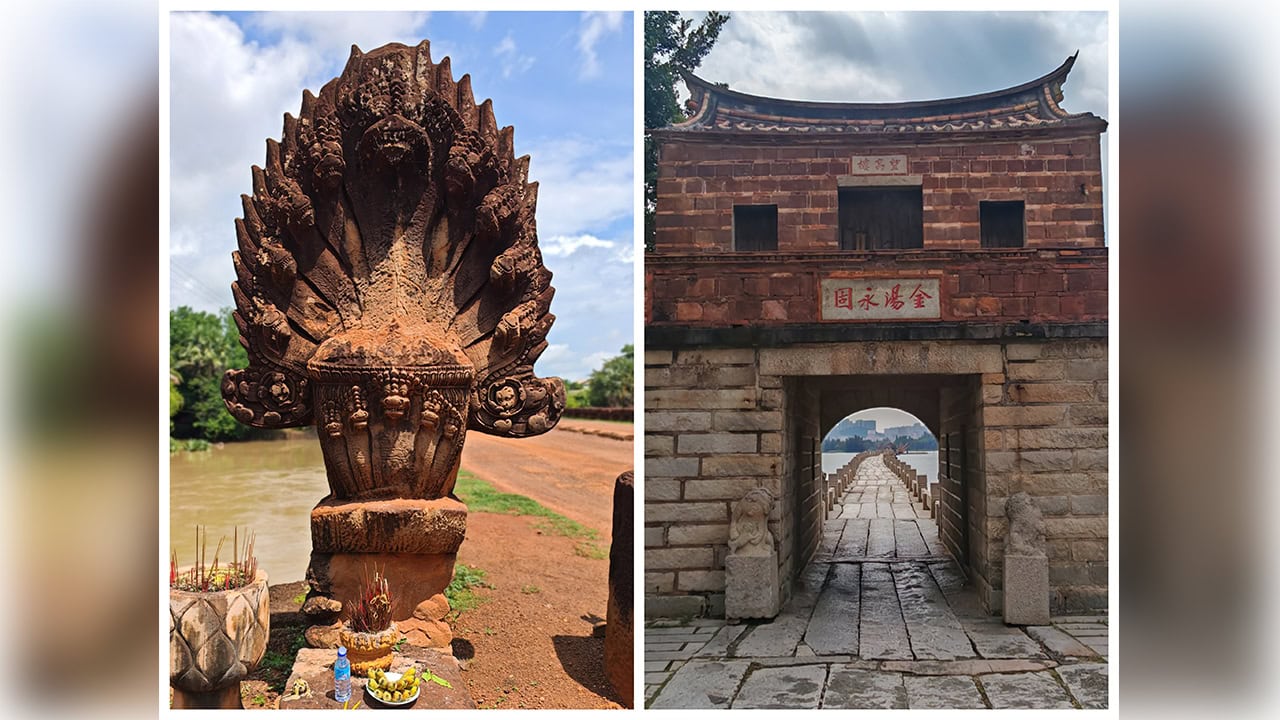
Nearly nine hundred years ago, two very different teams of builders were tackling the same basic problem — how to span water with stone — on opposite sides of mainland China and Southeast Asia.
In Fujian province, Chinese masons were laying enormous granite slabs across a tidal estuary to connect two bustling towns. Roughly 1,500 kilometres to the southwest, Khmer engineers were assembling corbelled laterite arches over a river on the overland road network of the Angkorian Empire. The results — China's Anping Bridge and Cambodia's Kampong Kdei Bridge — are among the most impressive surviving examples of medieval bridge engineering.
Anping Bridge: Riding the Tides
Anping Bridge links Anhai town in Jinjiang with Shuitou town in Nan'an, both administered by Quanzhou in Fujian. Construction started in 1138 during the Southern Song dynasty and finished in 1152, meaning the bridge has been standing for roughly 874 years.
Stretching about 2.25 kilometres and ranging from 2.9 to 4 metres wide, it earned the nickname Wuli Bridge — Five-Li Bridge — because its span equals roughly five traditional Chinese li. Along its length, 362 water openings sit between approximately 360 piers, though some counts put the figure at 361.
The longest granite beam spans about 11 metres, and the heaviest slab tips the scales at close to 25 tonnes. With no mechanical cranes to help, builders loaded the stone onto boats and relied on rising and falling tides to manoeuvre the slabs into position atop the piers. Some local accounts suggest the granite was partly quarried on Kinmen and neighbouring islands, though the full source list has never been pinned down.
The soft, muddy seabed posed its own challenge. Engineers addressed it with a sleeper-log foundation: wooden logs were laid across the muck, and heavy stones were placed on top, gradually pushing the structure down until it reached a load-bearing layer. Oysters colonising the submerged sections further stabilised the masonry, their shells accumulating around it and shielding the stone from wave action and erosion.
Three distinct pier shapes responded to the varying current patterns — rectangular, single-pointed or half-boat-shaped, and double-pointed boat-shaped. The design choices reflected a sophisticated understanding of hydrodynamics and local tidal behaviour.
Anping Bridge supported overland trade between Quanzhou and communities to its south, a reminder of the enormous prosperity maritime commerce brought to the region during the Song and Yuan dynasties. In 2021 it was inscribed as one of 22 component sites of the UNESCO listing "Quanzhou: Emporium of the World in Song–Yuan China."
Kampong Kdei Bridge: Corbelled Arches and Naga Balustrades
Cambodia's Kampong Kdei Bridge, located in Chi Kreng district of Siem Reap province, offers a striking counterpoint from roughly the same era. Associated with the reign of King Jayavarman VII, it served the imperial road network connecting Angkor with other parts of the Khmer Empire.
At about 87 metres long, it is far shorter than Anping, but its construction is no less ingenious. Instead of long beams on piers, builders stacked laterite blocks into more than 20 corbelled arches — a technique in which each successive layer of stone projects slightly inward until the two sides meet at the top. Flanking the roadway, nine-headed naga balustrades blend structural function with Khmer religious symbolism and artistic flair.
Two Cultures, Two Solutions
The two bridges addressed similar engineering problems with fundamentally different tools and philosophies. Anping served a maritime trading hub and depended on tidal forces, timber foundations and piers shaped to manage currents. Kampong Kdei carried travellers across a river on an inland road and relied on corbelled arches, laterite masonry and culturally resonant decorative elements.
Their continued survival demonstrates that medieval bridges were never just transport infrastructure. They were lasting expressions of economic ambition, technical knowledge and cultural identity — monuments to what two civilisations chose to build, and how.