As Rain Returns, Nepal Flood Survivors Endure Cold—and Leaking Tents
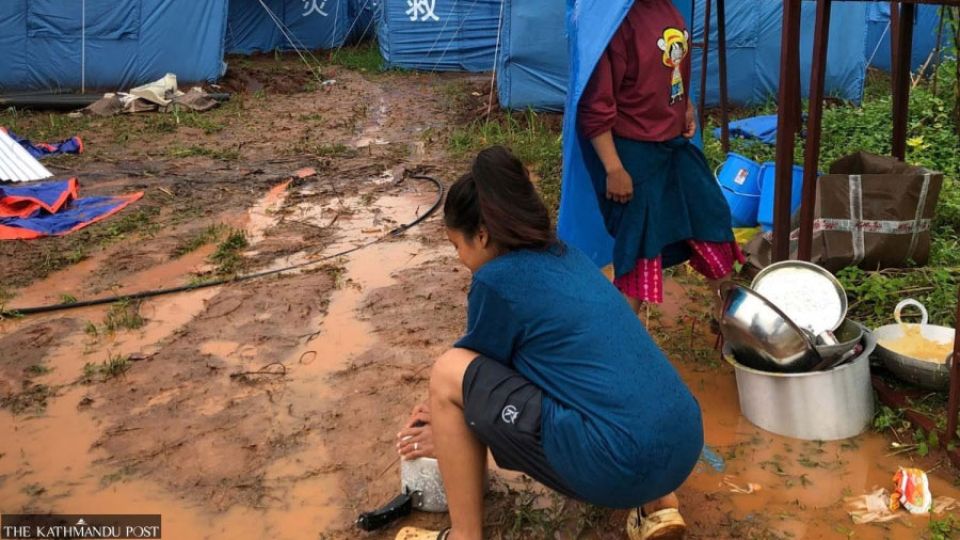
In Rasuwa and Nuwakot—the districts most severely affected by late-August flash floods—new rainfall began before rivers had fully receded, compounding the suffering of families already displaced and sheltering under makeshift tarps.
At a temporary camp near Shree Karma Dhechenling Monastery in Bandre, Nuwakot, Juthe Tamang described how rain seeped through his tent, soaking blankets and bedding. To cope, he added a second tarpaulin overhead. With three family members sharing the cramped space—including his wife, granddaughter, and himself—he was forced to send his 77-year-old mother-in-law to stay overnight with neighbors due to overcrowding and the worsening conditions.
Nepal has faced persistent rain since Thursday, driven by a low-pressure system forming in the Bay of Bengal. Across villages like Pipaltar, Dhunge, Gerkhu, Bhaise, and Trishuli Bazar, displaced families have struggled to stay dry under tarps stretched across open fields and higher ground. Some spend sleepless nights guarding their few possessions; others have layered extra tarps that still cannot prevent mud and sludge from accumulating beneath them.
Temba Tamang, displaced from Khalte in Rasuwa’s Uttargaya Rural Municipality and staying at the Pipaltar holding center, explained the difficulty of finding shelter once night falls during rain. Although his family of three received one bed as relief, only one person can use it at a time. He lets the children sleep on it and sleeps on the floor himself. His wife survived the flood by chance—she had been away while he was working. Their children escaped too, having gone to a tuition class when the waters rose. It took four days for Temba to locate and reunite with them.
At the Lito holding center in Nuwakot, dampness has raised concerns for vulnerable groups. Wet clothing and bedding are especially troubling for children, nursing mothers, and the elderly. Many families lost nearly all their clothes in the flood and now rely entirely on relief supplies—runouts that are growing faster than they can be replenished in the unrelenting damp.
Cooking has also become a challenge. Without access to enclosed cooking areas, some resort to burning firewood outdoors in the rain or enduring smoke indoors. Binita Tamang, staying at the same monastery camp, said the wood she received was too wet to ignite. While some centers have distributed induction cooktops, most tents lack electricity, forcing residents to depend on shared cooking spaces that often run out of fuel.
Norsang Tamang, also from Khalte, longs for permanent shelter. His spouse remains missing, and he now lives with his one-and-a-half-year-old grandson, three-year-old granddaughter, blind mother-in-law, and asthmatic elderly mother in a single tent. “With nowhere else to go,” he said, “I’m staying with relatives, like many others. Everything we owned is gone.”
The rain has also intensified fears of landslides and rising river levels near hillside and riverside camps. In Bogati village, retired soldier Bhimsen Thapa noted how survivors are becoming increasingly anxious, particularly after days of continuous rainfall and the unsettling sound of swollen rivers.
Physical access to government offices has also deteriorated. Mudslides and slippery roads prevent the elderly and infirm from reaching distribution centers to collect relief or obtain necessary documentation. Survivors are calling out for safe shelter, dry clothing, medical supplies, clean bedding, and tarpaulins to replace the failing ones.
Local officials urge families to remain in designated centers while long-term solutions are organized. Krishna Prasad Humagain, assistant chief district officer of Nuwakot, emphasized staying put until alternative arrangements are ready. In Rasuwa, Dhruba Prasad Adhikari noted five active holding centers so far, adding that initial planning has identified potential resettlement sites and recommendations have been forwarded to the central government.
Dharam Raj Uprety, chief executive of the National Disaster Risk Reduction and Management Authority, confirmed that plans are underway to establish permanent settlements in Rasuwa and Nuwakot, with land assessments underway across Syaphrubesi, Timure, and Bidur. The goal, he said, is to help survivors choose safe locations—even if legal adjustments are required to repurpose forest or private land.
For many, however, waiting is not an option. Pemba Dechen Tamang, who is seven months pregnant and displaced from Khalte, has searched fruitlessly for a rented room since arriving at the center. Of her thirteen-member extended family, only she remains accounted for—everyone else is missing. “Everywhere I ask, they tell me there are no rooms available,” she said.