Bangkok absorbs heaviest hit from US$754 million in Thai flood damage as firms scramble to respond
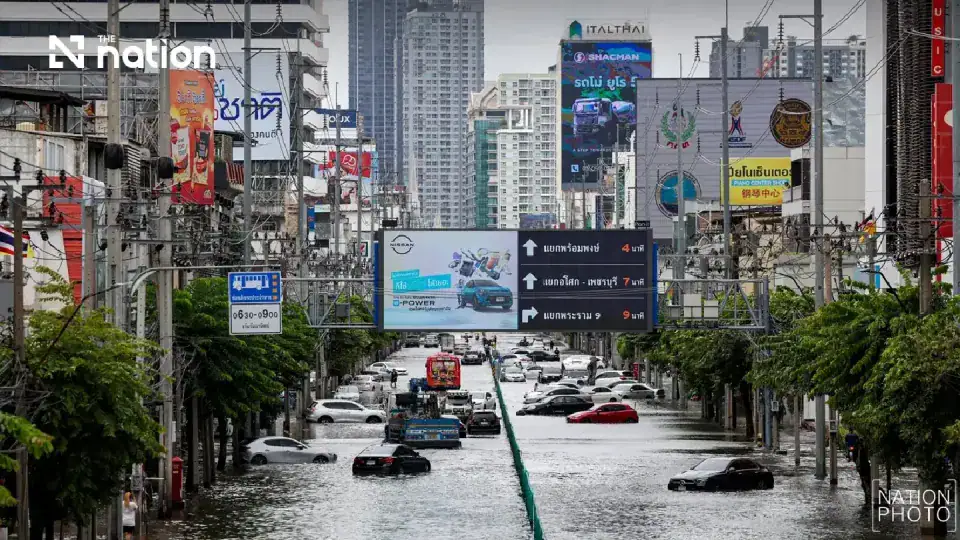
BANGKOK – Flooding that swamped 48 provinces, Bangkok included, between September 24 and 27, 2026 could inflict economic damage of 25.345 billion baht under a moderate-damage projection, according to Assoc Prof Aat Pisanwanich of Rangsit University's Faculty of Economics. The capital bears the largest share at 10.586 billion baht, as inundation brought commerce, services and travel to a standstill. Business representatives cautioned that few companies were ready for the severity and length of the flooding.
The deluge followed days of relentless rain from September 24 to 26, when slow-moving storm systems dumped water faster than Bangkok's drainage network could handle, inundating the capital and nearby provinces.
Economists weigh losses over different timeframes
Aat's modelling spans low-, moderate- and high-damage scenarios across four days. Nationwide losses are projected between 16.896 billion and 33.793 billion baht, translating to a third-quarter GDP drag of 0.36–0.73%, with the moderate case at 0.55%.
Under that moderate scenario, Bangkok's 10.586 billion baht in estimated losses far outstrips the East at 5.5208 billion baht and the Central region at 4.401 billion baht. Aat's regional GDP impacts break down as 0.23% for Bangkok, 0.12% for the East, 0.10% for the Central region, 0.04% each for the North and Northeast, and 0.02% for the South, summing to 0.55%.
Wholesale and retail trade makes up 23.4% of Bangkok's projected losses in Aat's analysis, trailed by finance and insurance at 14.9% and public administration at 10.3% – evidence that the disruption reaches well beyond factories into urban commerce, services and government operations.
Thanavath Phonovichai, president of the University of the Thai Chamber of Commerce and chief adviser to its Centre for Economic and Business Forecasting, produced a separate estimate covering a shorter window. Speaking to Bangkok Biznews, he said preliminary surveys confirmed flooding in 21 provinces. With travel restricted, spending was expected to dip over September 25–27, while flooded Bangkok shopping centres saw sales slump and petrol stations risked lower fuel volumes.
"A three-day shock nationwide would cost the economy about 10 billion baht and trim GDP by just 0.05%, so the overall hit should be manageable," Thanavath said. "This assumes the problems in Bangkok and neighbouring provinces resolve within three days, though flooding in other areas could persist for three to seven days."
The two assessments differ in timeframe and geographic scope and should not be read as a single consensus figure.
CIMB Thai flags softer spending, urges flood spending
Dr Amonthep Chawla, senior executive vice-president and head of research at CIMB Thai Bank, told Bangkok Biznews the economic fallout should stay contained if waters recede within two or three days. Even so, he said consumption, tourism, construction and consumer confidence warrant close attention.
Amonthep expects households to delay big-ticket purchases in favour of food and essentials. Repair work could spur spending once floodwaters retreat, though fragile purchasing power and shaky confidence may cap the rebound. Broken supply chains could also stall deliveries even where customers are willing and able to pay.
He noted that flooding may deter some domestic and international tourists without prompting outright cancellations, as visitors reroute to Chiang Mai, Phuket or other destinations – hitting hotels, restaurants, transport firms and retailers in flooded zones.
The property market, already wrestling with weak demand, faces added strain, Amonthep said. Flood-risk concerns could cool interest in detached houses outside the city, while central Bangkok condominiums may see little extra pressure beyond existing softness. Some households may instead opt to rent in the city centre.
Amonthep argued that 1,000 baht in cash aid spread over two months falls well short of covering flood losses, and extending handouts into next year would do little to fix Thailand's structural low growth and weak purchasing power. He pressed for dedicated investment in flood prevention, workable water-retention zones and job programmes that employ local residents rather than relying on cash transfers alone.
He does not foresee a major hit to foreign direct investment, and exports should keep moving. Agricultural output, however, could suffer, pushing prices up and eroding Thailand's competitiveness.
"If flooding lasts only two or three days in affected areas and the situation stays under control, the economic damage will be limited," Amonthep said. "But confidence in the government's handling of the crisis must be monitored. If that confidence erodes, people will have to fend for themselves, which means higher costs over the long run."
FTI says businesses were caught off guard
Pimjai Leeissaranukul, chair of the Federation of Thai Industries (FTI), said weather forecasts and heavy-rain warnings had not translated into sufficient preparation. Even retailers were unprepared for water to pile up to the extent seen, she said.
Pimjai warned that industrial disruption could ripple through entire production and supply chains, from raw-material sourcing and worker commutes to transport and deliveries. Machinery, electrical systems, warehouses and stockpiles were all exposed.
The FTI called on businesses to urgently assess risks and revisit continuity plans. Firms should verify raw-material supplies, delivery commitments and transport routes, while lining up backup routes and service providers to limit the chance of prolonged stoppages.
Brokerages split on market and growth fallout
Gun Hathaisattha, chief investment strategist for retail research at CGS International Securities (Thailand), expects flood worries to shave roughly 10–15 points off the Stock Exchange of Thailand (SET) Index on September 28.
Gun said property stocks could absorb the heaviest selling, as flooding sways decisions on detached homes and condominiums. Retail shares may also swing as consumers tighten their belts.
Foreign investors were starting to scrutinise the implications for tourism and restaurants, Gun added, with hotels in holiday provinces also at risk. CGS International held its 2026 GDP growth forecast at 2.5%.
Sorrabhol Virameteekul, assistant managing director and head of investment strategy at Kasikorn Securities, flagged a potential 0.1–0.2% downside to its 2026 GDP projection of around 2%.
Sorrabhol pointed to the extension of the second phase of the Thais Help Thais Plus programme as a bright spot. That said, a month-long flood could inflict losses of 20–40 billion baht, or 0.15–0.25% of GDP, in his view.
He stressed that the potential damage remains well short of the 2011 catastrophe, which affected nearly 30 million rai, or 4.8 million hectares.
Kitpon Praipaisarnkit, deputy managing director of UOB Kay Hian Securities (Thailand), struck a more upbeat tone. He said the economy still has growth momentum despite flooding in several areas and projected the SET Index to trade between 1,580 and 1,620 points, hovering near 1,600.
Kitpon does not believe the floods will inflict damage severe enough to dent economic fundamentals. He argued that conditions today differ markedly from 2011, noting that water levels in the four main dams are considerably lower than they were ahead of that disaster.