Bangkok bears the largest share of Thailand’s estimated US$754 million flood losses
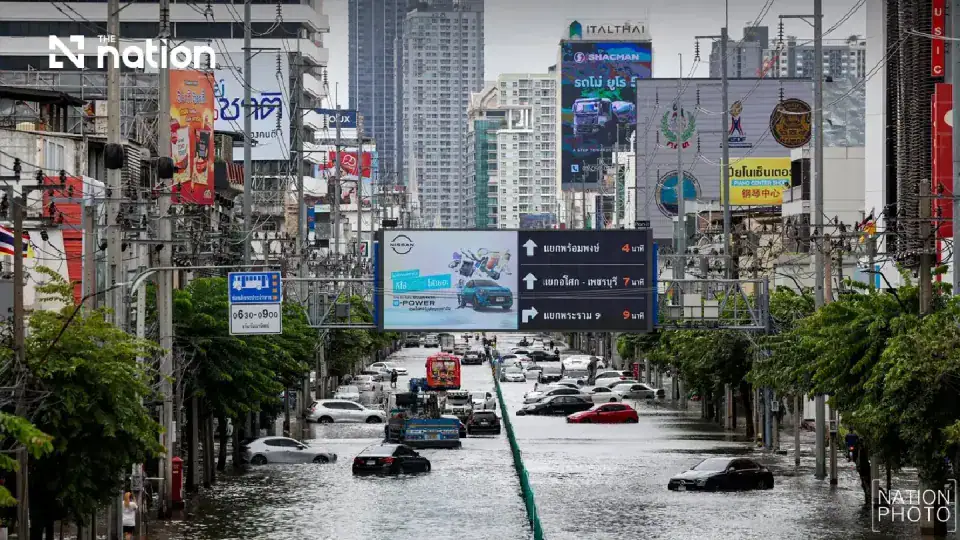
Flooding across 48 provinces, including Bangkok, from September 24 to 27, 2026 could cause economic losses of 25.345 billion baht under a moderate-damage scenario, according to Assoc Prof Aat Pisanwanich of Rangsit University’s Faculty of Economics.
Bangkok is expected to account for the largest portion of the losses, at 10.586 billion baht, as flooding disrupts trade, services and travel. Business leaders have warned that many companies were not prepared for the scale and persistence of the inundation.
The estimates follow heavy rain from September 24 to 26, when slow-moving rotating clouds produced downpours that exceeded Bangkok’s drainage capacity and flooded large areas of the capital and nearby provinces.
Economists assess losses over different periods
Aat’s estimate covers four days and uses low-, moderate- and high-damage scenarios. Nationwide losses range from 16.896 billion to 33.793 billion baht, with the impact on third-quarter gross domestic product (GDP) estimated at 0.36% to 0.73%. The moderate scenario implies a 0.55% GDP impact.
Under that scenario, Bangkok’s estimated losses of 10.586 billion baht are higher than those projected for the East, at 5.5208 billion baht, and the Central region, at 4.401 billion baht.
Aat’s regional estimates put the third-quarter GDP impact at 0.23% for Bangkok, 0.12% for the East, 0.10% for the Central region, 0.04% each for the North and Northeast, and 0.02% for the South, adding up to 0.55%.
Wholesale and retail trade represents 23.4% of Bangkok’s projected losses, followed by finance and insurance at 14.9% and public administration at 10.3%. The breakdown shows that the disruption reaches beyond factories to urban commerce, services and government activity.
Thanavath Phonvichai, president of the University of the Thai Chamber of Commerce and chief adviser to its Centre for Economic and Business Forecasting, produced a separate estimate covering a shorter period.
Thanavath said preliminary checks found flooding in 21 provinces. Travel restrictions were expected to reduce spending from September 25 to 27, while flooding at some Bangkok shopping centres was likely to hurt sales. Petrol stations could also see lower fuel demand.
He estimated that a three-day disruption would result in nationwide losses of 10 billion baht and trim GDP by just 0.05%, describing the overall effect as limited. That projection assumes problems in Bangkok and neighbouring provinces last three days, while flooding in other areas could continue for three to seven days.
The two estimates cover different timeframes and geographic areas, so they should not be treated as a single agreed loss figure.
Bank calls for flood-prevention investment
Dr Amonthep Chawla, senior executive vice-president and head of research at CIMB Thai Bank, said the economic impact should remain contained if flooding in affected areas clears within two or three days. He said consumption, tourism, construction and public confidence nevertheless needed close monitoring.
Amonthep expects households to delay major purchases at first and prioritise food and other necessities. Repair activity could support spending once the water recedes, but weaker purchasing power and confidence may restrict the recovery. Logistics problems could also prevent deliveries even when consumers have the means to buy.
Flood reports could discourage some domestic and overseas tourists from travelling, although many may change destinations rather than cancel their trips. Chiang Mai, Phuket and other locations could benefit from visitors switching away from Bangkok, while hotels, restaurants, transport companies and retailers in affected areas would suffer.
The property market could face further pressure on top of already weak demand. Concerns over flood exposure and location may discourage purchases of detached homes outside the city, while central Bangkok condominiums may be less affected beyond existing market conditions. Some households could opt to rent centrally located condominiums instead.
Amonthep said a 1,000-baht cash payment spread over two months would not make up for flood-related losses. Extending handouts into the following year would also do little to address Thailand’s weak growth and low purchasing power, he said.
He called for clearly targeted spending on flood prevention, workable water-retention plans and employment for local residents in related projects, rather than relying mainly on cash assistance.
Amonthep does not expect a major effect on foreign direct investment, and said exports should continue operating. However, damage to agricultural production could reduce supply and push up prices, hurting Thailand’s competitiveness.
He said the economic effect would be limited if flooding lasted only two or three days and remained manageable. However, he warned that any loss of confidence in the government’s ability to handle the crisis could force people and businesses to bear higher costs themselves over the longer term.
Industry group says companies were not ready
Pimjai Leeissaranukul, chair of the Federation of Thai Industries, said weather forecasts and warnings of heavy rain had not led to sufficient preparations. Even retailers had not anticipated floodwater accumulating on such a large scale.
She warned that industrial disruption could spread throughout production and supply chains, affecting raw-material purchases, employees’ commutes, transportation and deliveries. Machinery, electrical equipment, warehouses and stock were also at risk.
The industry group urged companies to assess their exposure immediately and update business-continuity plans. Businesses should verify raw-material supplies, delivery obligations and transport routes, while arranging alternatives to reduce the risk of extended disruption.
Brokerages offer differing market outlooks
Gun Hathaisattha, chief investment strategist for retail research at CGS International Securities (Thailand), expects flood concerns to pull the Stock Exchange of Thailand (SET) Index down by about 10 to 15 points on September 28.
Property stocks could face the heaviest selling pressure because flooding may affect decisions to purchase houses and condominiums. Retail shares could also be volatile as consumers reduce discretionary spending.
Foreign investors were beginning to focus more closely on the effects on tourism and restaurants, Gun said, noting that hotels in tourist provinces could also be affected. CGS International kept its 2026 GDP growth forecast at 2.5%.
Sorrabhol Virameteekul, assistant managing director and head of investment strategy at Kasikorn Securities, estimated that the floods could reduce its 2026 GDP forecast by 0.1% to 0.2%, from a projection of about 2%.
He cited the extension of the second phase of the Thais Help Thais Plus programme as a potential support. However, a month-long flood could produce losses of 20 billion to 40 billion baht, equivalent to 0.15% to 0.25% of GDP.
Sorrabhol said the potential damage was still well below the level of the 2011 disaster, when almost 30 million rai, or 4.8 million hectares, were affected.
Kitpon Praipaisarnkit, deputy managing director of UOB Kay Hian Securities (Thailand), was more optimistic. He said the economy had retained its growth momentum despite flooding in several areas and predicted that the SET Index would trade between 1,580 and 1,620 points, around the 1,600 level.
Kitpon does not expect the floods to inflict damage severe enough to weaken Thailand’s economic fundamentals.