Beyond the War, Maritime Powers Search for Ways to Keep Sea Lanes Open
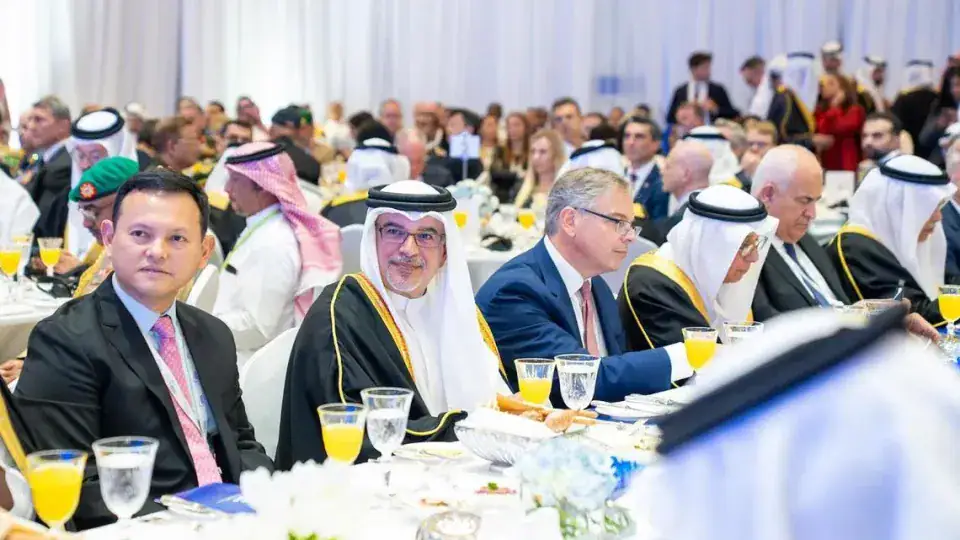
At the Manama Dialogue in Bahrain, leaders from around the world, Singapore among them, stressed that shipping chokepoints must never again be able to put global trade and people's livelihoods at risk. The crisis in the Strait of Hormuz has made that vulnerability impossible to ignore.
With the war involving Iran possibly nearing its end, one way or another, maritime nations are starting to think about what comes next.
A widely shared view has emerged from the Hormuz standoff, where tensions between the United States and Iran have disrupted shipping for months. Globalisation and common economic interests have not prevented conflict, but economies and livelihoods should never again be left at the mercy of chokepoints at sea.
That was one of the main conclusions of this year's Manama Dialogue, organised by the International Institute for Strategic Studies. Singapore was one of many countries to make the point at the region's leading security conference in West Asia.
Zaqy Mohamad, Singapore's acting minister for Muslim affairs and senior minister of state for defence, told a maritime security panel on November 1 that the lesson of Hormuz is not that the world has become too interconnected. Rather, security cooperation has failed to keep pace with interdependence. “We must not allow insecurity to become the new normal,” he said.
Zaqy noted that no single country can protect the maritime commons on its own. He called on coastal states and nations that rely on the waterways to take the lead, with support from other users of these routes. He warned that if countries simply accepted higher risks, longer routes and rising costs as the normal price of doing business, maritime insecurity would become a permanent part of international trade. He called that outcome unacceptable.
He proposed three areas of cooperation: sharing information about threats in a timely way, being ready to act together, and protecting what lies out of sight. Maritime security, he said, is no longer just about guarding the ships we can see. It also means protecting the undersea infrastructure that our connected world depends on. As technology advances, defence forces will need to work together to identify emerging risks and develop joint responses.
Singapore already works with Indonesia, Malaysia and Thailand through the Malacca Strait Patrol. It also contributes to Combined Task Force 151 in the Gulf of Aden and Combined Task Force 153 in the Red Sea. Zaqy said these multinational naval partnerships show the country's commitment to maritime security well beyond its own region.
Efforts to find lasting solutions have been gathering momentum for some time. When Bahrain, the host of the Manama Dialogue, held the UN Security Council presidency in April, it made maritime security and freedom of navigation a priority, drawing attention to the erosion of longstanding navigation norms.
Greece, a country with a long seafaring history, did the same during its Security Council presidency in October.
Greek Prime Minister Kyriakos Mitsotakis told the dialogue that the Council broadly agrees the issue is extremely urgent. That urgency, he said, comes not only from the actions of states but also from non-state actors who can use inexpensive technology to disrupt shipping and threaten undersea cables.
Mitsotakis stressed that the problem is not confined to the Middle East. He pointed to the Black Sea, the world's other troubled theatre, which has been badly affected by the Russia-Ukraine war. Only days earlier, a Greek-owned container ship had been sunk in the western Black Sea. Large quantities of Ukrainian grain remain stuck in warehouses because disrupted shipping has kept it from reaching markets that are waiting for it.
Even so, Mitsotakis urged Europe to pay more attention to West Asia. He argued that Greece, as a leading maritime nation, has a strong stake in freedom of navigation.
A senior Asian diplomat attending the dialogue said he expected Singapore's call for coastal states and waterway users to take the initiative to resonate across the region. In the cases of Hormuz and the Black Sea, he said, the world is looking to credible powers to lead collective efforts to keep the seas open.
He recalled that during the Iraq War, Singapore joined the “coalition of the willing” by sending a landing ship tank. Strong powers stepping forward to lead, he argued, would give smaller states the confidence to join such efforts. “Even token participation helps make the larger point,” he added.
The dialogue closed amid widespread fears that another US-Israeli attack on Iran could come soon after the US midterm elections. Iran has threatened to retaliate against Gulf states and other US-friendly governments across the region. Qatar has led diplomatic efforts over the weekend to head off another round of fighting.
Because of Iranian threats, the Strait of Hormuz, which once carried much of Asia's energy supplies, remains almost completely closed. October saw the highest number of attacks on shipping in a single month since the war began in late February.
Tehran also has considerable influence over traffic in the Bab el-Mandeb Strait and the Red Sea, through irregular forces in Yemen that are allied with or sympathetic to it.
Meanwhile, oil prices remain well above normal, fuelling global inflation. Iran has a 2,000-kilometre coastline along the Persian Gulf and the Gulf of Oman, from which it could disrupt commerce passing through Hormuz. It also has a small presence on the Caspian Sea, where it trades with Russia and Central Asia.
West Asia expert Vali Nasr told an RSIS conference in Singapore in October that control of the Hormuz strait has become strategically more important to Tehran than keeping its nuclear programme.
Indeed, in negotiations to end the war, Iran has demanded special privileges over the strait, similar to those Turkey received under the 1936 Montreux Convention. That agreement left Ankara as a kind of supervisor of the Bosphorus.
Such demands sit uneasily with most countries in Asia.
For South-east Asian states like Singapore, open and secure sea lanes are economic lifelines, Zaqy said at the dialogue. Although security conditions differ from region to region, the principles governing maritime passage must remain consistent.
“What happens in Hormuz or Bab el-Mandeb matters far beyond the Gulf. We must not allow attempts to restrict transit passage there to undermine navigational rights in the Straits of Malacca and Singapore, or any other strategic waterway,” he said.
On the same panel, Indian Foreign Secretary Vikram Misri bluntly stated that Indian seafarers using the Strait of Hormuz had been attacked by more than just Iranian actors, and that India had been outspoken about it. He was referring to US strikes on merchant crews enforcing a naval blockade meant to stop Iranian exports. The most serious incident came on June 10, when a US missile attack killed three Indian seafarers.