Cambodia-Japan Trade Passes $2.2 Billion as Joint Committee Targets Investor Confidence
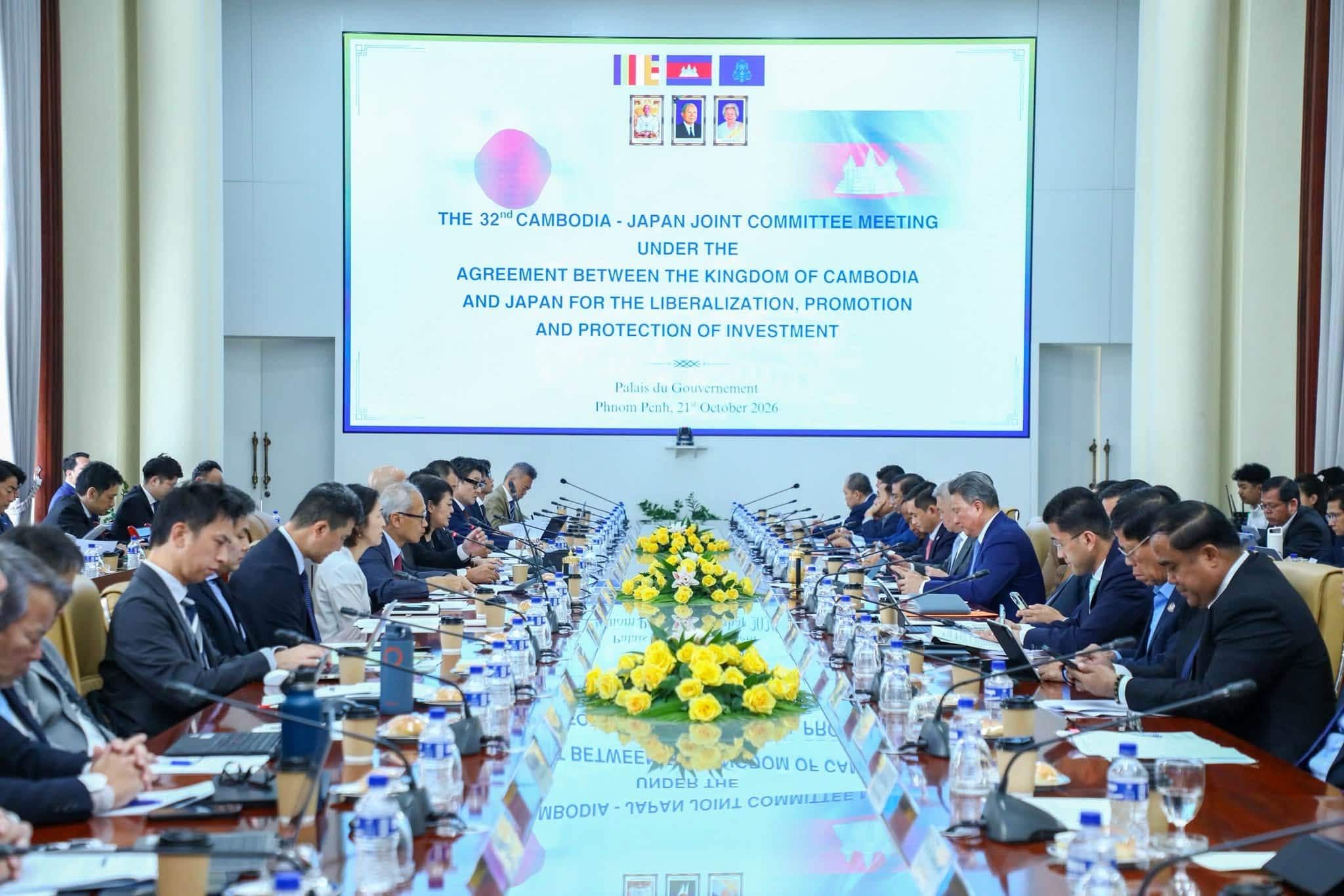
Cambodia and Japan have committed to deepening their economic, trade and investment ties, with a particular focus on improving the business climate, responding to investor concerns and strengthening confidence. Bilateral trade surpassed $2.2 billion in the first nine months of 2026.
The pledge came at the 32nd meeting of the Cambodia-Japan Joint Committee, held in Phnom Penh on October 21 under the bilateral agreement on investment liberalisation, promotion and protection. Sun Chanthol, first vice-chairman of the Council for the Development of Cambodia (CDC), and Japanese Ambassador Ishizuki Hideo co-chaired the session.
Cambodian government officials, members of the Business Co-creation Team (BCT) and representatives of the Japanese Business Association of Cambodia (JBAC), the Japan International Cooperation Agency (JICA), the Japan External Trade Organization (JETRO) in Cambodia and the ASEAN-Japan Economic and Industrial Cooperation Committee (AMEICC) also took part. The gathering gave the government and Japanese companies a forum to raise obstacles and work toward practical solutions that make it easier to do business and attract new investment.
The CDC described the meeting as an effective official channel for dialogue and a strategic platform linking the Royal Government with the Japanese private sector. It said the forum allows timely responses to requests and helps remove a range of business barriers.
The government also reaffirmed its commitment to steadily improving the investment climate. It said transparency and predictability are meant to attract and retain Japanese investors and to build lasting confidence in doing business in Cambodia.
Ambassador Ishizuki, who has recently taken up his post, pointed to investment opportunities for Japanese firms. He also outlined several challenges that will require cooperation among relevant stakeholders to resolve.
Beyond bilateral discussions, the committee reviewed a report on cooperation between AMEICC and the BCT. It also received updates on the activities, achievements and future plans of JICA and JETRO in Cambodia.
For Cambodia, closer ties with Japan matter not only for widening export markets but also for technology transfer, workforce upgrading and building domestic production capacity. These benefits, however, depend on new investment being linked to local supply chains and local businesses.
The joint committee meets twice a year under the investment agreement. It serves as a regular channel for raising business concerns and advancing economic cooperation between the two countries.
Trade Figures
Data from the General Department of Customs and Excise of Cambodia (GDCE) show that bilateral trade reached nearly $2.24 billion in the first nine months of 2026, up 19.5 per cent from the same period in 2025.
- Exports to Japan: $1.45 billion, up 24.1 per cent
- Imports from Japan: approximately $791.39 million, up 11.9 per cent
Japan is now Cambodia's fourth-largest trading partner, after China, the United States and Vietnam. Cambodia mainly sends garments, footwear, travel goods, agricultural products and certain industrial goods to Japan. In return, it buys machinery, vehicles, spare parts and manufacturing equipment.
Outlook on Investment
Economist Hong Vanak of the Royal Academy of Cambodia said political stability, geographic location, investment laws, a skilled workforce and transport infrastructure are among the main reasons Cambodia attracts investment. He added that the country must work harder to position itself as an appealing destination and to find buyers in a wider range of markets.
He stressed that discussions aimed at making the investment climate more favourable are vital for drawing Japanese and other foreign investors into direct investment in Cambodia. He also said better infrastructure, lower transport costs and more efficient business procedures would help Cambodian products compete more effectively abroad.