Cambodia Moves to Cut Repeat Paperwork in Business Registration
Cambodia is looking to lower red tape for companies and investors. Its proposed reforms would let government ministries share company documents electronically, so businesses no longer have to hand over the same details again each time they register, apply for a license, or seek investment approval.
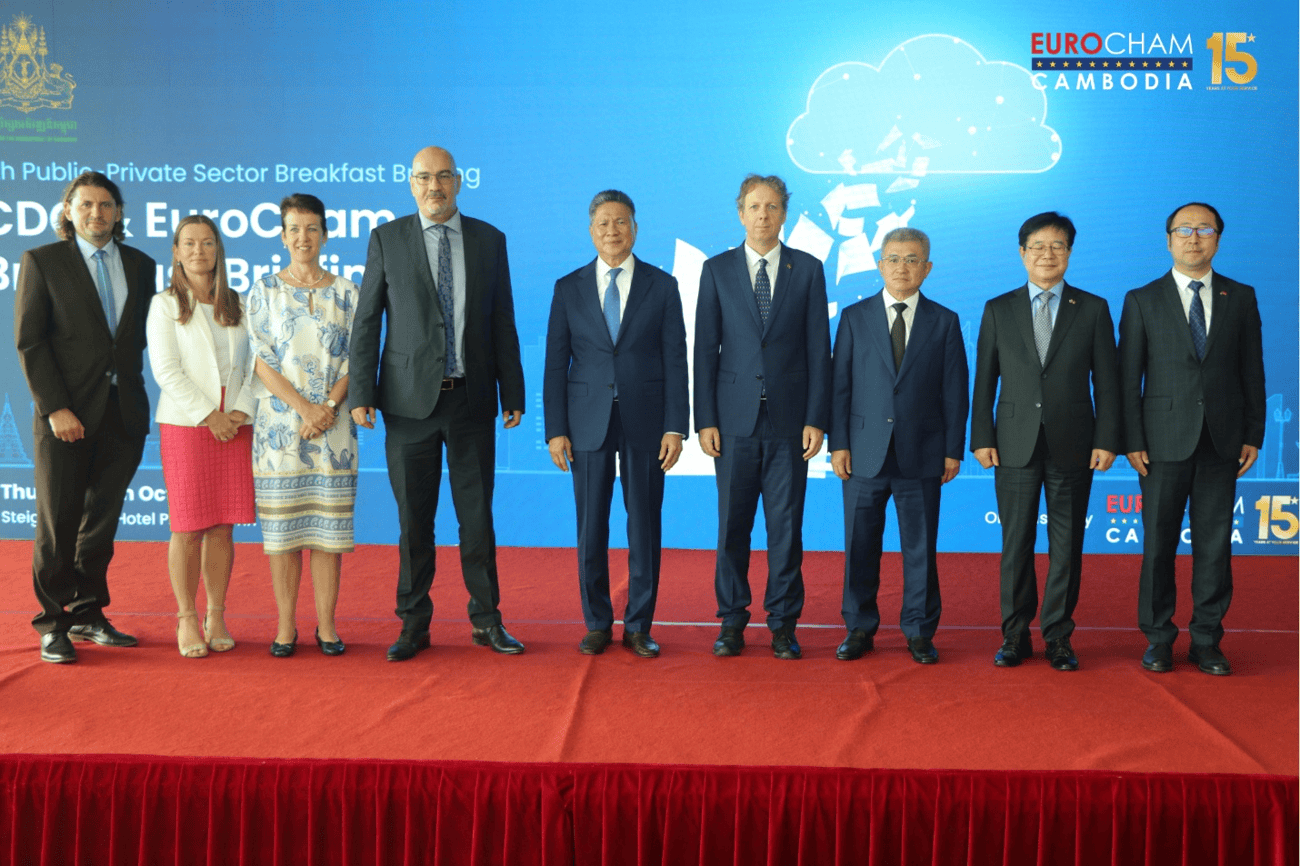
The proposals were debated at the fourth Public-Private Sector Breakfast Briefing, held in Phnom Penh on October 8 and co-organised by the Council for the Development of Cambodia (CDC) and the European Chamber of Commerce in Cambodia (EuroCham). The discussion centred on three practical reforms meant to streamline business procedures, strengthen coordination between state institutions, and make investment approvals quicker and more predictable.
According to a statement EuroCham issued on October 8, the reforms cover three areas:
- Digital company documents: A single electronic version of key documents would be accepted by every relevant ministry.
- Standard photo requirements: Official documents would follow one photo standard, ideally so a company supplies a digital photo once and several institutions can use it.
- A unified list of business activities: A public classification list would make sure an activity approved at company registration stays valid through later licensing and administrative steps.
Investors often run into these hurdles at every stage, from investment approval and incorporation through to licensing and the start of operations. Under the first proposal, companies would file essential documents electronically, and the verified information would then be shared among agencies rather than submitted separately to each one.
The ideas grew out of an initiative launched at the third Public-Private Sector Dialogue, where the CDC, relevant ministries and private-sector representatives reviewed the administrative steps investors must complete before they can begin operating. A baseline assessment in June identified several ways to cut repeated documentation. EuroCham says coordination between the CDC and the ministries has since led to a measurable drop in duplicate document requests, although it did not release figures showing how large the reduction was.
The latest talks also looked at a longer-term goal: a government-wide “once-only” principle, under which information given to one institution would not have to be requested again by another. Ministries would exchange verified data through the Cambodia Data Exchange platform (CamDX) instead of asking businesses for the same papers over and over.
EuroCham Cambodia chairman Tassilo Brinzer said excessive regulatory and administrative burden is a worldwide problem, not one unique to Cambodia, stemming from systems that have not kept pace with the modern economy. He added, however, that few countries have the same chance for quick and meaningful reform, given Cambodia’s firm governance structure, and that the country could leapfrog ahead with sustained effort. He pointed to Singapore as proof that efficient, business-friendly rules and a strong rule of law across all commercial areas can help an economy grow.
Deputy Prime Minister Sun Chanthol, who is the CDC’s first vice-chairman, and EU Ambassador Igor Driesmans attended the briefing, along with officials from government institutions. Diplomatic missions from Germany, the Czech Republic, the United States, South Korea and Japan were represented, as were the American, Korean, Chinese, Japanese and Cambodian chambers of commerce. The meeting was held under the Chatham House Rule so that government officials, diplomats and business representatives could speak openly.
The initiative is part of a continuing partnership between the CDC and EuroCham to improve the investment climate by removing regulatory and administrative obstacles. It receives support from the European Union’s Global Gateway initiative and the German development agency GIZ.
The discussions point to a sustained push by government and industry to make investment procedures more efficient. The open question now is whether the changes can be put in place before the end of the year. The statement did not say whether any of the proposals have received formal government approval, and it gave no implementation deadlines.