Can China Help Cambodia and Thailand Revive Border Talks Through the Mekong-Lancang Framework?
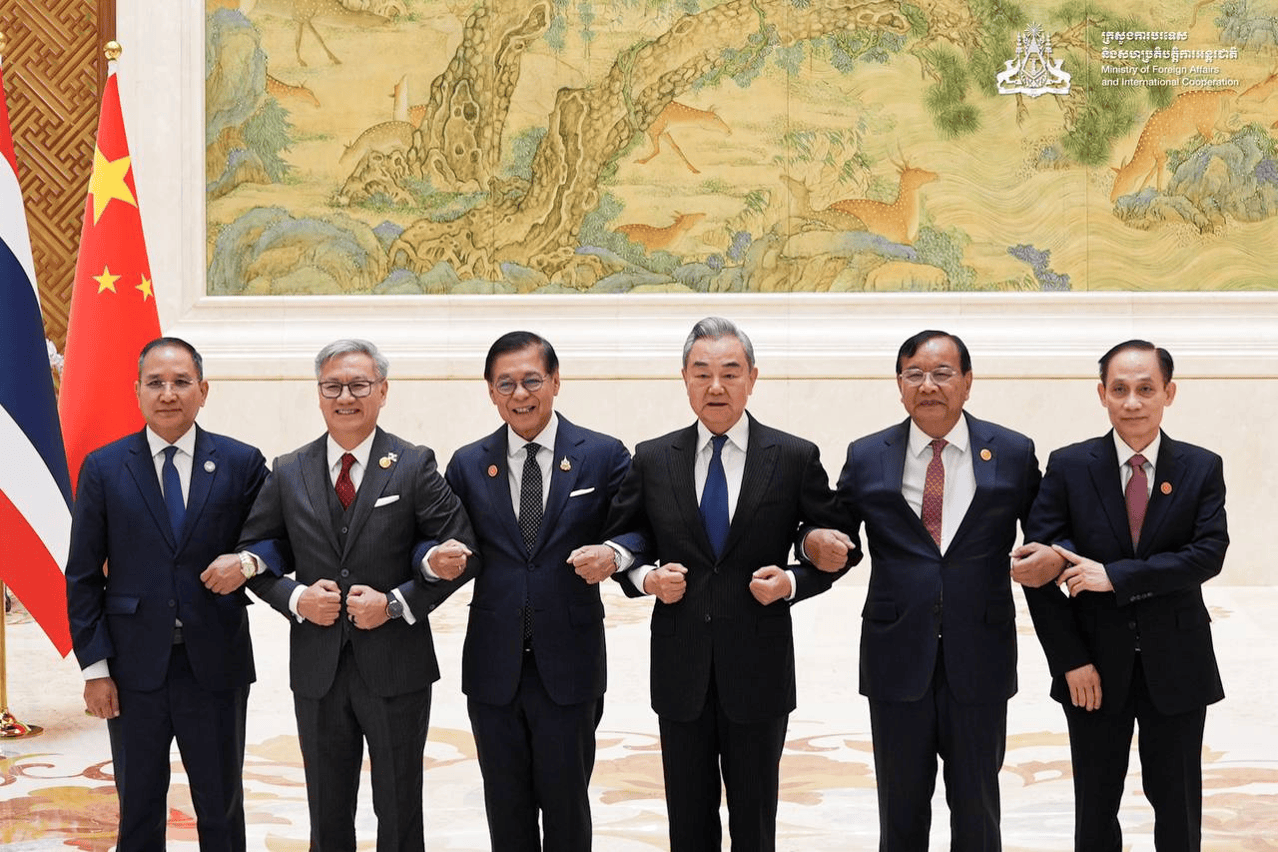
China hosted the 11th Foreign Ministers’ Meeting of the Mekong-Lancang Cooperation (MLC) on November 4. Ministers from Cambodia and Thailand both attended, even though the two neighbors still assert competing sovereignty claims and remain locked in a tense border dispute.
Held under the theme “Building a Community with a Shared Future: Opening a New Chapter for Mekong-Lancang 2.0,” the gathering had not produced any official outcomes at the time of reporting.
Photos showed Cambodian Foreign Minister Prak Sokhonn and his Thai counterpart, Sihasak Phuangketkeow, posing for a group picture with their Chinese host and ministers from Laos, Myanmar, and Vietnam.
A statement from Cambodia’s foreign ministry did not say whether the border dispute came up. Instead, it focused on Sokhonn’s remarks about the progress made under the MLC framework over the past decade. He said that as the partnership moves into its Mekong-Lancang 2.0 phase, Cambodia has set priorities to ensure the cooperation produces concrete benefits for ordinary people. These include preserving peace, managing water resources responsibly, tackling transnational crime, and strengthening people-to-people ties.
The border issue was not explicitly on the agenda, but Kin Phea, director-general of the Royal Academy of Cambodia’s International Relations Institute, sees the meeting as a diplomatic opening for Cambodia, Thailand, and China to revisit the dispute. He noted that the three countries’ foreign ministers had already met in December 2025 at the Fuxian Meeting in Yunnan province, China, which produced the Fuxian Consensus. In his view, the current meeting could offer another chance to move dialogue forward.
“The Mekong-Lancang meeting is an important diplomatic platform,” Phea said. “Other countries may not have raised the Cambodia-Thailand border issue, but I believe Cambodia’s foreign minister did, because this cooperation is meant to keep the peace and stability, fight transnational crime and deepen people-to-people bonds.”
He argued that reaching those goals requires member states to discuss their border problems. Regional peace and stability, he said, cannot be guaranteed while neighbors remain hostile along their frontiers. Such tensions do more than strain bilateral ties. They also disrupt trade, investment, tourism, and cross-border exchanges, especially through regional supply chains.
The timing is significant. The day before the meeting, Thai Prime Minister Anutin Charnvirakul said his government would not seek to restore normal relations with Cambodia, citing disputes over land and maritime boundaries as well as security concerns.
Phea read Anutin’s comments as a political move designed to protect his career and his grip on power. He said the ruling Bhumjaithai Party has benefited from rising nationalist sentiment in Thailand. He also stressed that power in Thailand does not rest with the prime minister alone, since the military and public nationalism also shape political decisions.
“Anutin’s comments are a political signal meant to sustain his career,” Phea said. “He came to power partly because of the border issue and the incursion into Cambodian territory. He is riding a wave of nationalism that he depends on. If that sentiment fades, he will struggle to stay afloat, so he has every reason to keep the border closed and the issue alive.”
Phea added that the situation remains complicated. Even if Anutin wanted to repair relations with Cambodia, he could not do it alone. The outcome would also depend on Thailand’s royal palace, which holds considerable influence over the military, and on nationalist feeling within Thai society.