China's Communist Party Opens Key Plenum on Self-Governance and Party Building
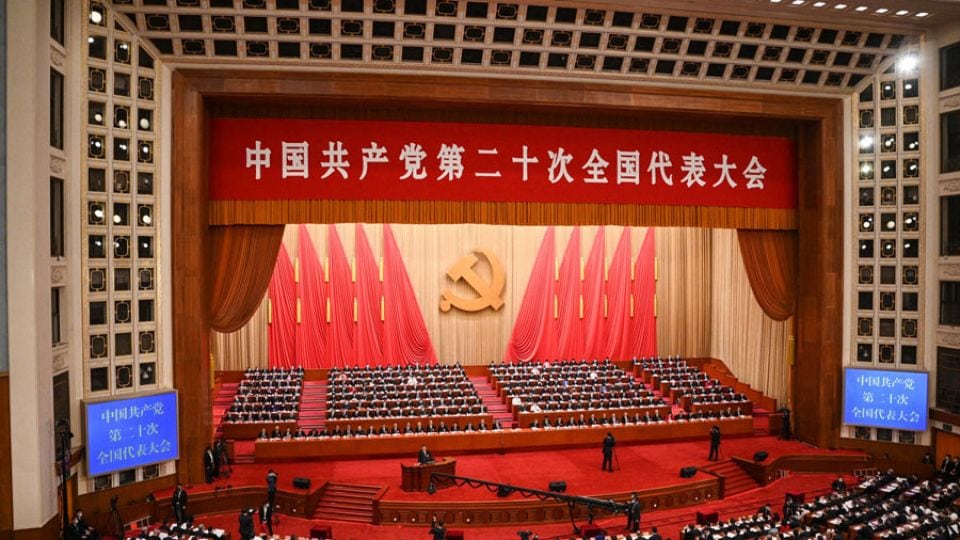
As the Communist Party of China (CPC) opened its fifth plenary session of the 20th Central Committee in Beijing on Monday, analysts said the meeting offers a useful window into how a party more than a century old can stay vital, drive high-quality national development and deliver for ordinary people during a period of global upheaval.
The significance of the gathering becomes clearer when viewed through the framing Xi Jinping has chosen. Speaking on Thursday at an event marking the 90th anniversary of the Red Army’s Long March, Xi, who also serves as general secretary of the CPC Central Committee, described China’s new stage of development as a fresh “Long March” for the Party and the Chinese people. He argued that firm Party leadership is essential to building a modern socialist country in every respect.
Xi stressed that the Party must uphold its overall leadership and the centralized, unified leadership of the Central Committee, keep pushing full and rigorous self-governance forward, and remain the core of leadership for socialism with Chinese characteristics.
Agenda of the plenum
The main task of the session is to study major issues in advancing the Party’s full and rigorous self-governance. According to the official notice, the Political Bureau will also report on its work to the Central Committee. The meeting runs through Thursday.
Expert views
Wang Yiwei, vice-president of the Academy of Xi Jinping Thought on Socialism with Chinese Characteristics for a New Era at Renmin University of China, said many countries are stuck in governance gridlock as global growth slows, geopolitical tensions rise and technological rivalry intensifies. In that context, he said, China’s approach to Party self-governance offers useful lessons for nations seeking stable and sustainable development. He called Party self-reform the fundamental political safeguard for China’s progress, showing that ruling parties can maintain effective governance over the long term by reforming themselves.
A decade of Party discipline
Full and rigorous self-governance has been a central theme since the 18th National Congress in 2012. That December, the central leadership introduced an eight-point code designed to improve Party conduct, curb official privileges, combat bureaucracy and corruption, and bring the Party closer to the public. The wider anti-graft campaign has since combined tighter oversight, institutional refinement and ongoing action against misconduct by members and officials.
Since 2013, the Central Committee has also run nine rounds of large-scale study and education campaigns to keep members focused on their mission and connected to the people.
Disciplinary inspections
Disciplinary inspection, a form of political supervision carried out by higher-level Party bodies over lower-level ones, is used to identify problems, deter wrongdoing, drive reform and support development. The 20th Central Committee has completed seven rounds of inspections since 2023. An eighth round is about to begin, targeting Party organizations at the Ministry of Education and 31 universities, according to an announcement on Saturday.
Reaching the grassroots
With more than 100 million members and over 5 million primary-level organizations, the Party says it has addressed the long-standing problem of weak grassroots governance and extended its leadership to every level of national administration. Grassroots branches act as bridges between the state and society, making sure residents’ demands are heard and acted on in local governance.
Despite significant progress over the past decade, the Party acknowledges that its self-governance now faces new conditions and challenges, shaped by profound shifts in the international and domestic environment.
At the fifth plenary session of the Central Commission for Discipline Inspection in January, Xi described the fight against corruption as a major struggle the Party cannot afford to lose. He said the anti-graft situation remains grave and complex, and that removing the conditions that breed corruption is still a demanding task, requiring a firm stance so that corrupt officials have nowhere to hide.
What to expect
Experts expect the plenum to set new strategic direction for long-term, rigorous Party governance, with higher standards and more concrete measures to tackle pressing problems in Party building. Xia Lu, a research fellow at Renmin University’s National Academy for Development and Strategy, told China Global Television Network that the session is not about discipline for its own sake. Rather, it aims to make the Party a more cohesive, cleaner and more capable instrument of governance. She described the meeting as “pivotal and bridging,” saying it should provide strong political backing for high-quality development and Chinese modernization.
Party-building theory
Xi Jinping Thought on Party Building, a core component of Xi Jinping Thought on Socialism with Chinese Characteristics for a New Era, serves as the systematic theoretical guide for strengthening the Party. Cheng Meidong, director of the Institute for Historical Studies of the CPC at Peking University, said this thinking answers the key question of what kind of long-term ruling Marxist party to build and how to build it, and that it carries practical weight for strengthening both the Party and the nation.