Clashes and Blockades Enter Third Day as Bangladesh Garment Unrest Spreads
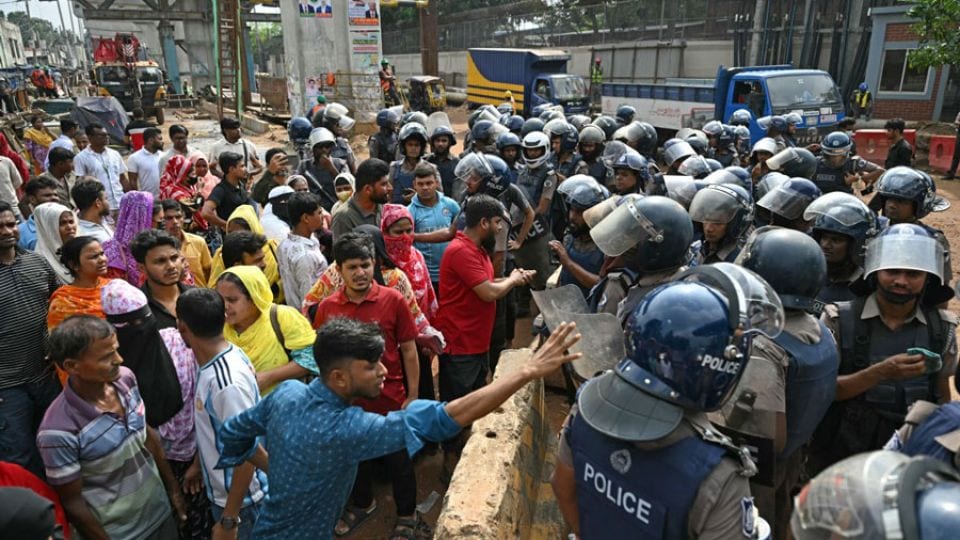
Garment workers demanding a minimum monthly wage of Tk 30,000 kept up their protests for a third straight day, blocking highways and clashing with police in Savar and Gazipur. Traffic was also disrupted in the capital's Mirpur district and in Narayanganj. More than 400 factories were shut down or suspended operations, and police made dozens of arrests across the industrial belt.
According to police, 264 factories in Savar-Ashulia and 150 in Gazipur declared holidays or halted production for the day. Protesters set fire to two vehicles in Gazipur, one of them a police vehicle, and a lorry in Savar.
Violence was less intense than on Sunday, but police still filed cases in both districts. Three cases in Gazipur name 4,000 people, and four cases in Mirpur name 11,000. At least 82 people have been arrested in the affected areas.
The current minimum wage of Tk 12,500 took effect on December 1, 2023, after an increase from Tk 8,000.
Home Minister Salahuddin Ahmed warned of strict legal action against anyone involved in the violence or in efforts to destabilise the garment sector. After meeting leaders of the BGMEA and BKMEA at the Secretariat, he accused some factory owners, including former ministers and lawmakers, as well as people acting under the banner of labour groups, of fuelling the unrest. He said the government has identified some of those involved and gathered audio and video evidence of attacks, and that law enforcement has been told to respond firmly to any further violence.
Clashes and Arson
In Gazipur, workers blocked several points along the Dhaka-Tangail highway for more than six hours, starting at 7:30am, bringing traffic to a standstill. Around noon, protesters set fire to a police pickup at Naojor and another pickup at Safipur. An industrial police inspector, who asked not to be named, said officers were inside the vehicle when it was set alight. No injuries were reported immediately.
A Gazipur district official said a member of the Border Guard Bangladesh was hurt during protests in Kaliakair. BGB headquarters deployed nine platoons to Gazipur to contain the unrest.
Around 12:30pm, more than 100 workers were seen on the Dhaka-Tangail highway, some carrying sticks and rods. They left the road about half an hour later, with one worker saying, "The movement will continue. We will be back shortly."
Mohammad Taherul Haque Chowhan, an additional police commissioner in Gazipur, said at least 22 people had been arrested.
Hazrat Billal, publicity affairs secretary of Bangladesh Garment Workers' Solidarity, said the unrest grew out of long-running grievances, low pay, and restrictions on forming trade unions. He said workers should not be blamed for the violence and called for breaking up alliances between factory owners and dishonest labour leaders. He also urged workers to pursue their demands through peaceful, democratic channels.
In Savar and Ashulia, the protests spread to Zirabo, Kathgora, Ghoshbagh, and Narsinghpur. They began around 9:30am when workers at New Age Group factories walked out, according to witnesses and police. The crowds then gathered outside factories owned by the Ananta and Ha-Meem groups. Some protesters threw bricks and stones at police near a Ha-Meem factory, and others pelted Bengal Plastic Pipes Ltd on Kathgora Road. Police said at least eight factories were attacked.
Clashes broke out twice when protesters tried to block the Nabinagar-Chandra highway at Kabirpur. Police responded with tear gas and water cannon. Fighting also erupted in Ghoshbagh along the Abdullahpur-Baipail road, and a lorry was torched in Narsinghpur. Two people were detained for attacking law enforcers, according to Mohammad Tariqul Islam, officer-in-charge of Ashulia Police Station, who could not immediately confirm whether they were garment workers.
The unrest also reached Ullail in Savar, where workers gathered beside the Dhaka-Aricha highway, and several factories in Padmar Mor and Hemayetpur stopped production. Mohammad Mominul Islam Bhuiyan, superintendent of Industrial Police-1, said workers from protesting factories had persuaded employees at nearby plants to join them. He also claimed outsiders had taken part and said police would act on available information.
In Dhaka, police twice drove back protesters trying to march from Mirpur-14 toward Mirpur-10 around 9:00am. Around 11:00am, workers from factories in Shewrapara and Purabi in Mirpur-6 tried to assemble in Mirpur-2 and march toward Mirpur-10, prompting police to fire tear gas.
Hasan Mohammad Nasher Rikabdar, deputy commissioner of police for Mirpur, said four cases had been filed over the unrest, with two more being prepared at the Kafrul and Rupnagar police stations over Sunday's incidents. At least 60 people were arrested.
One of those detained, Rajib Chandra Das, was arrested in Uttara for allegedly setting fire to a police vehicle on Sunday. Khalid Mansur, officer-in-charge of Uttara West Police Station, said Das confessed to the offence in a Facebook post.
In Narayanganj, workers from several factories blocked the Dhaka-Narayanganj Link Road, halting traffic. Tarek Al Mehedi, additional superintendent of police for crime and operations, said workers gathered at Katherpul in Kutubail around 11:30am and blocked the road about 30 minutes later.
Shahidul Islam, a worker at Metro Knitting and Dyeing Mills Ltd, said he earns Tk 12,500 a month, but house rent alone takes Tk 5,500, and he needs another Tk 10,000 for groceries. "We have only one demand: our monthly wages must be raised to Tk 30,000."