Fingerprints Suggest Women and Children Helped Build China's Terracotta Warriors
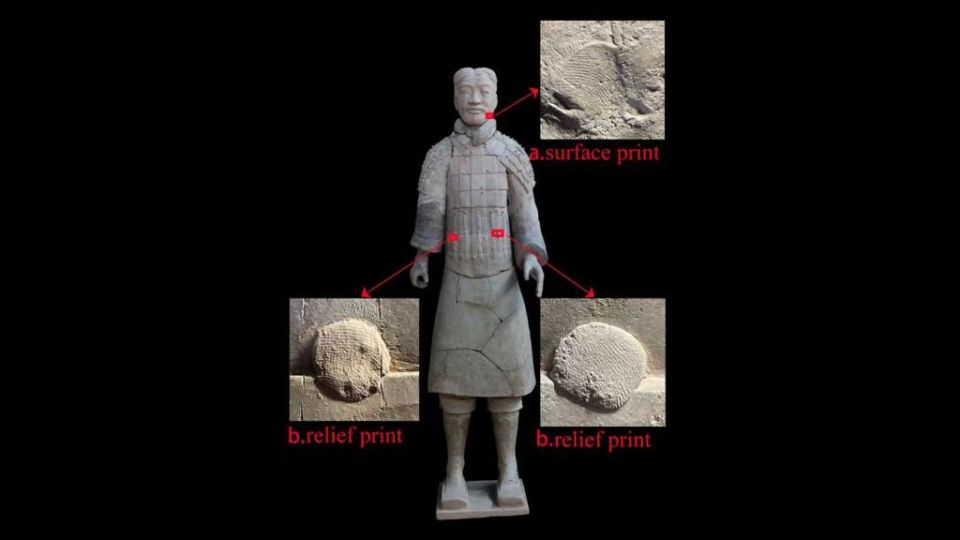
A new fingerprint study challenges the long-held view that only men made the Terracotta Warriors. Researchers examined 79 well-preserved fingerprints left in the clay of the figures and found that the workforce was far more mixed than previously thought.
Using a Bayesian statistical model, the team measured the average width of the fingerprint ridges. Unlike many earlier studies, they analyzed ridge width together with ridge density, meaning how many ridges fit into a given area, rather than treating them as separate factors. The results showed that only about 45 percent of the prints came from adult men. Roughly 33 percent came from adult women, and around 22 percent came from juveniles under 15.
According to the researchers, these findings provide the first quantitative biological evidence that women and children were part of this diverse workforce. They may have helped produce, transport, and assemble the figures.
The study was published in the Journal of Cultural Heritage. It was a joint effort between the Emperor Qinshihuang's Mausoleum Site Museum in Xi'an, Shaanxi Province, and the School of Archaeology at Shandong University in Jinan, Shandong Province.
Of the 79 prints, 73 were left directly on wet clay by craftspeople as they shaped and trimmed the figures. The other six were made when workers gripped small, pre-formed clay pieces, such as armor studs and belts, while attaching them. Most prints were found on separately made parts, including heads, arms, and armor. This matches the known production method, in which components were molded and shaped by hand, then assembled one at a time.
The presence of youthful prints fits with what is known about the Qin apprenticeship system, in which young people assisted skilled master craftsmen.
Supporting Evidence From Qin Records
Other sources point in the same direction. Scattered references in Qin legal documents and excavated objects show that women and children worked on lacquerware under state supervision. Inscriptions on the lacquer items use titles such as da nyuzi (adult woman), xiao nyuzi (young girl), and xiao nanzi (young boy).
Li Xiaoxi, an archaeologist at the museum who led the research, said it remains an open question whether the same pattern applied to the massive Terracotta Army project. The answer would have major implications for how historians understand Qin labor and social organization.
The paper also explains that the Qin household registration system set the age for labor and military service at 15, and that female convicts were assigned to earthwork labor. State-run workshops added another layer by offering formal training through master artisans. Together, these rules and practices created the framework that allowed women and minors to join large construction projects.
Similar Finds From Other Periods
Women's involvement in major building work appears in other archaeological evidence as well. Bricks from the ancient city wall of Nanjing, built between the late Yuan (1271–1368) and early Ming (1368–1644) dynasties, bear carved names that are commonly associated with women. Makers often recorded their names to claim credit for their work. In Shaanxi, female skeletal remains were found at a pottery workshop and are believed to belong to craftswomen from the Western Zhou period, around the 11th century to 771 BC.
Zhao Mengwei, director of the academic research department at the Nanjing City Wall research center, explained that the wall and the Ming imperial capital were state projects that drew millions of laborers from across the country. The population had fallen sharply after the wars at the end of the Yuan Dynasty, so women inevitably filled gaps in the workforce.
Zhao said the available clues strongly suggest that many women took part. Some worked as kiln artisans who fired the bricks, while others prepared clay and carried earth for brick production. Firing skills could be passed down within artisan families or picked up quickly under heavy workloads.
She also argued that many more women likely handled essential behind-the-scenes tasks, such as preparing meals for craftsmen and conscripted workers. Although these contributions were rarely written down, Zhao said they were vital and showed that cultural heritage is built by the broad mass of ordinary people.