
How Migratory Birds Point the Way Toward Stronger Economies and Ecosystems
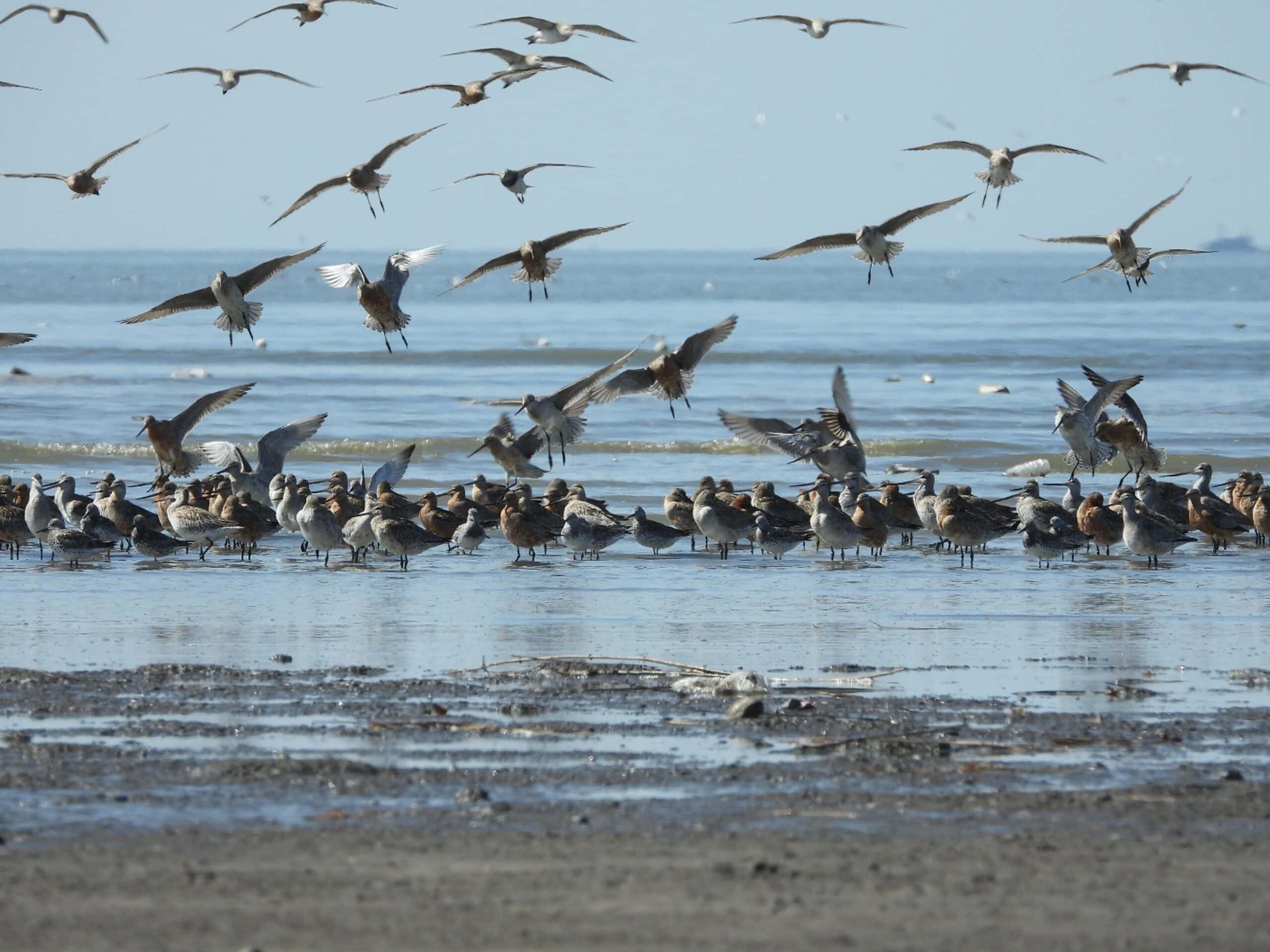
Some of the most important infrastructure on Earth has no owner, no borders, and no name most people would know. It is the vast network of wetlands that keeps migratory birds alive as they cross the planet on epic journeys.
The eastern bar-tailed godwit, a small shorebird, holds the record for the longest nonstop flight of any bird — an gruelling 11,000-kilometre trek made possible only because a chain of healthy wetlands exists along the way to sustain it. The godwit's story is really a story about connection: the deep, inseparable link between nature conservation and human prosperity, since millions of people also depend on these same wetlands for their livelihoods.
The godwit is just one of millions of birds that travel the East Asian–Australasian Flyway, a corridor linking breeding grounds in the Arctic and northern Asia with destinations across the globe. Even record-breaking fliers need to land. Along its route spanning Alaska, New Zealand, and China, the godwit relies on wetlands to rest, feed, and recover before pushing onward. If a single stopover site is lost or degraded, the burden shifts to the remaining ones, eroding the resilience of the entire network.
The godwit's tale points to something bigger than the fate of one species. The Convention on Wetlands, established in 1971 as the world's oldest multilateral environmental agreement, formally recognises the diverse and essential roles these ecosystems play.
Wetlands designated as Wetlands of International Importance sustain hundreds of millions of people around the world. They supply food and clean water, support fisheries and farming, and buffer communities against floods and coastal storms. In effect, they function as natural infrastructure, providing services that would otherwise require expensive, human-built replacements. In terms of return on investment, wetlands rank among the smartest conservation spending available today.
Yet these assets are too often managed as purely local concerns, when their true worth can only be measured at a regional — even global — scale.
When a wetland degrades, the damage does not stay contained. Losing one site pushes more pressure onto those that survive, and the communities and industries relying on those remaining wetlands bear the cost. Healthy economies and healthy ecosystems are not separate goals; one cannot exist without the other.
Despite this, wetlands continue to vanish. Since 1970, roughly 22 percent of the world's wetlands have disappeared — an area equivalent to more than half a billion football pitches. One in four of the wetlands that remain are in poor ecological shape. The Asia-Pacific region feels these losses especially hard, as urbanisation, infrastructure expansion, shifting weather patterns, and population growth rapidly transform the landscape.
Investment in natural infrastructure has not kept pace with the scale of destruction, and what funding exists tends to be fragmented: small, site-by-site projects that protect individual wetlands without addressing the mounting pressure across the broader system. To bridge that gap, cross-border investment is needed at the scale of the flyway itself. Just as the godwits knit wetlands together through their journeys, so must collaborative funding and planning connect them.
Launched in 2021, the Regional Flyway Initiative (RFI) was built on precisely this principle, bringing the Asian Development Bank (ADB), BirdLife International, and the East Asian–Australasian Flyway Partnership together to safeguard migratory birds and the ecosystem services that wetlands deliver.
The initiative is grounded in rigorous science, pinpointing where investment can generate the greatest impact across the flyway. A recent study published in Scientific Reports, developed through the RFI, identified 147 priority sites across 10 participating countries, encompassing both coastal and inland wetlands that support threatened species.
With further scientific analysis strengthening the investment case, ADB and its partners aim to mobilise $3 billion over the next decade and support the protection or sustainable management of at least 50 of these priority sites, many of which are recognised by the Convention on Wetlands. The RFI, along with its expansion into other regions, represents a concrete contribution to the convention's mission of managing these sites effectively so that their number, area, and ecological connectivity continue to expand.
Early investments already illustrate how the approach works. In China's Hunan Province, a $308 million ADB-backed project at the South Dongting Lake Ramsar Site — a major freshwater wetland — will restore nearly 12,000 hectares of wetland habitat. The project aims to improve water quality and broader ecosystem health while delivering tangible benefits to thousands of local residents through sustainable farming, aquaculture, and eco-tourism.
Similar efforts are under way elsewhere. In the Philippines, a $3 million project supported by the Global Environment Facility spans three priority wetlands, linking habitat restoration and improved site management with sustainable livelihoods and greater natural resilience.
These projects are still in their early stages, but they demonstrate that biodiversity goals can be pursued alongside better water management, food security, and job creation — not as a separate environmental agenda, but as an integrated development strategy.
The flyway approach is also gaining momentum beyond Asia and the Pacific. The Americas Flyways Initiative, developed by BirdLife International, the National Audubon Society, and the Development Bank of Latin America and the Caribbean, is adopting a similar model. Meanwhile, the African–Eurasian Flyway Initiative, established by the World Bank and BirdLife International, reflects the same growing recognition: investing in priority wetlands along the flight paths of migratory birds delivers sustainable development benefits that extend far beyond any single site or national border.
The Regional Flyway Initiative is still young, but it is already showing what becomes possible when conservation and development stop competing for the same funding and start working from a shared blueprint.
Migratory birds survive because they depend on a chain of healthy habitats, not any single location. Investment now needs to follow the same logic — crossing borders the way the birds do.