King-Father Sihanouk’s Legacy Honoured as Cambodia Prepares to Host the Francophonie Summit
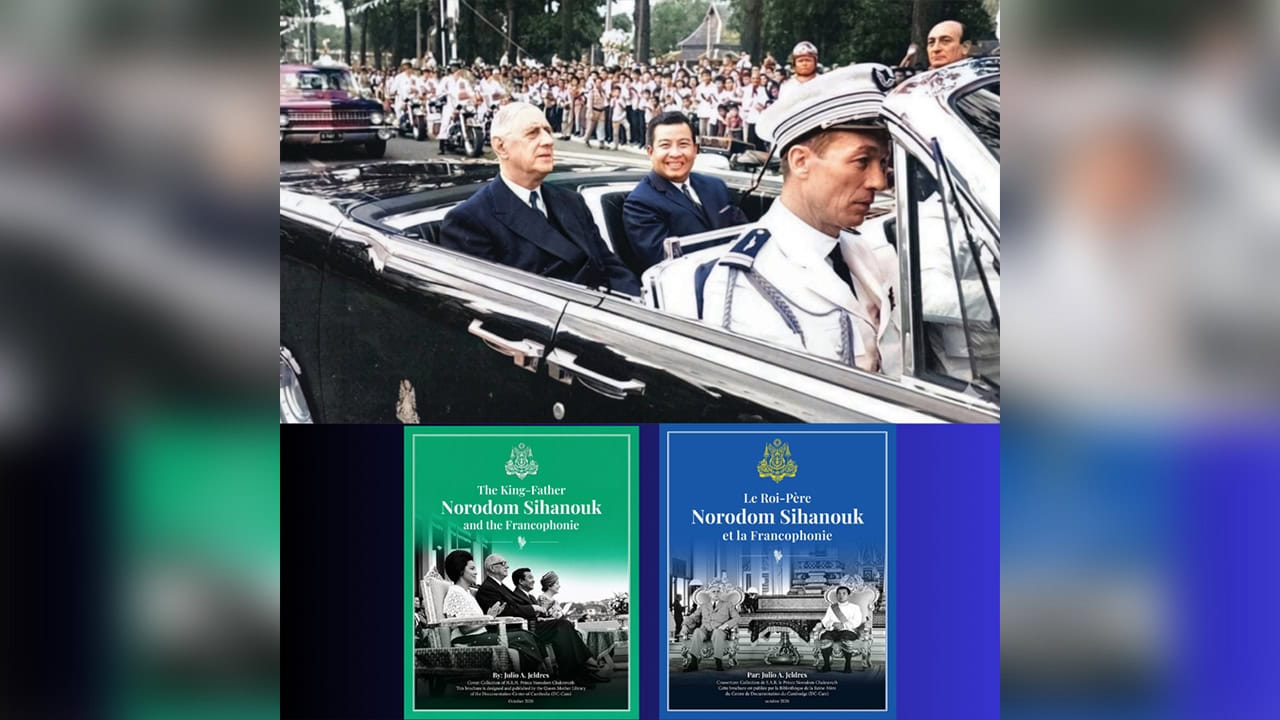
A new publication honouring the late King-Father Norodom Sihanouk highlights his efforts to promote the French language and his role in laying the groundwork for the international Francophonie movement. The book also portrays King Norodom Sihamoni as a fitting successor to his father’s commitment to linguistic and cultural diversity.
Titled The King-Father Norodom Sihanouk and the Francophonie, the 24-page booklet was produced by the Documentation Center of Cambodia (DC-Cam) and the Queen Mother Library. Author Julio A. Jeldres examines Sihanouk’s political career, his diplomatic relationships and his contributions to the community of French-speaking nations.
The release comes as Cambodia marks the 14th anniversary of Sihanouk’s death on October 15. He died in Beijing in 2012 at the age of 89. Over his lifetime he played a central part in the country’s modern history, including leading the campaign for independence from France in 1953.
Shaping the Francophonie
Jeldres places Sihanouk’s work within the Francophonie alongside that of three other leaders: Senegalese President Léopold Sédar Senghor, Tunisian President Habib Bourguiba and Nigerien President Hamani Diori. Together, they helped build the foundations of cooperation among French-speaking countries.
According to the book, Sihanouk understood the diplomatic and cultural value of French. He backed the idea of an international community that could unite countries through a shared language, rather than simply maintaining relationships inherited from the colonial era.
In a 1962 article for the French journal Esprit, Sihanouk argued that Cambodia could play an important role in spreading French culture across Asia. “It is not unknown, moreover, in the intellectual circles where Esprit circulates, that Cambodia occupies an honourable place among Francophone countries, and that it could be, if France wanted it and consented to the few sacrifices necessary for this, the ‘sanctuary’ of French culture in Asia,” he wrote.
He also linked culture to global standing: “The influence of a country, nowadays, is closely linked to its cultural influence.”
Language as a tool of diplomacy
The book describes how Sihanouk used French in journalism and diplomacy to explain Cambodia’s monarchy and present the country’s political stance to foreign audiences. After independence, he supported the expansion of secondary schools, universities and French-language publications, seeing the language as a gateway to scientific, technical and literary knowledge.
Jeldres also recounts how Sihanouk’s commitment to French affected him personally. In the foreword, he recalls writing as a Chilean student in 1967 to Cambodia’s mission to the United Nations and receiving a reply in French from the head of state. That response led him to learn French so he could continue corresponding with Sihanouk.
“That was the essence of the King-Father and the Francophonie!” Jeldres writes, pointing out that Sihanouk chose French even though he could have answered in English.
Cambodia’s path into the organisation
The booklet notes that Cambodia was not among the founding members of the organisation created under the Treaty of Niamey in March 1970. The coup that removed Sihanouk from power took place that same month. Cambodia later joined the Francophonie as an observer in 1991 and became a full member in 1993.
King Sihamoni’s role
The publication highlights King Norodom Sihamoni, who lived and studied in France for many years, taught dance in Paris and served as Cambodia’s representative to UNESCO before ascending the throne in 2004. It describes him as a “worthy direct heir” to his father’s legacy, pointing to his support for French-language education, cultural diversity and Cambodia’s involvement in Francophone institutions.
At the 19th Francophonie Summit in France in October 2024, Sihamoni reaffirmed Cambodia’s commitment to the organisation’s principles. “Cambodia wishes to reiterate its adherence to the values and principles of La Francophonie, as well as its deep commitment to cultural and linguistic diversity — a driver of human development,” he said.
Drawing on historical photographs, diplomatic accounts and quotations from prominent figures, the book presents Sihanouk’s legacy as reaching well beyond Cambodia’s domestic politics. It frames him as a figure who advanced language, education and cultural cooperation on the international stage.
Hosting the 20th Summit
The publication appears as Cambodia prepares to host the 20th Francophonie Summit in Phnom Penh on November 15–16. The summit’s central theme is “Reinvest in Peace for Shared Prosperity and Lasting Stability.” It will be only the second time an Asian nation has hosted the event, and it will bring together heads of state and government from across the French-speaking world.
A series of events will run alongside the summit from November 13 to 17. These include the FrancoTech 2026 exhibition, a France-Cambodia Business Forum and a public Francophonie Village at Wat Botum Park.