Laotian weavers create silk keffiyehs to support Palestine
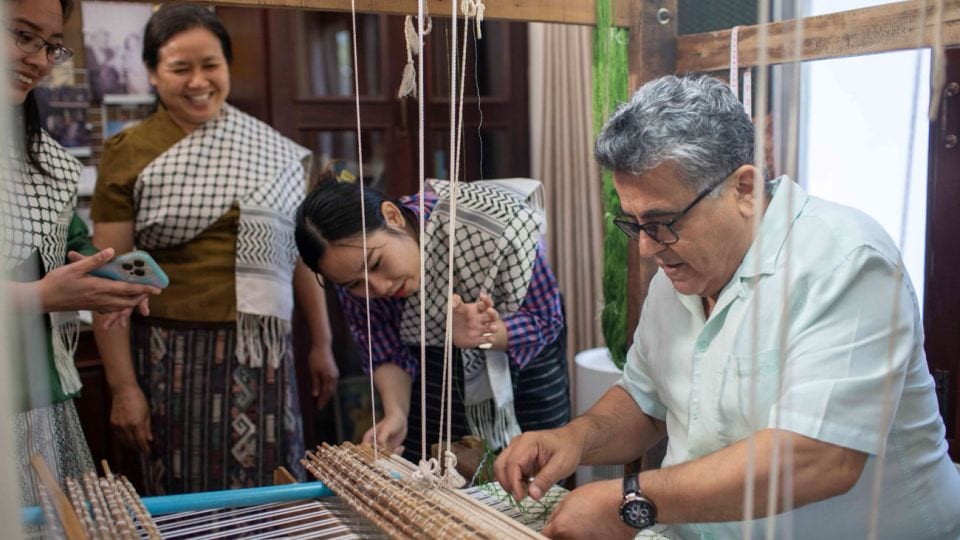
In Vientiane, Laos, a small team of textile workers is producing Palestinian keffiyehs from traditional Lao silk, linking the two cultures through craftsmanship and solidarity.
Each handwoven scarf can take more than a month to finish. Its design combines the Palestinian fishnet motif with the Lao naga, a serpent from local heritage that is associated with protection, strength and endurance. According to Lao mythology, the naga protected Lao communities from Siamese invasions and shared weaving knowledge with them. The fishnet pattern, meanwhile, reflects Palestinians’ ties to the sea, said project founder Souvixada Somsacksy.
A worker-led weaving project
Launched in December 2024, the Silk Keffiyeh project seeks to offer Lao weavers an independent, worker-led alternative to factory employment while generating financial support for Palestine.
Souvixada established the initiative with her godmother, Bouakham Phengmixay, known as Mae. After more than three decades in a textile factory, Mae hopes to pass her knowledge of a slowly disappearing weaving tradition to younger generations.
The project operates a full-time residency where participants learn traditional Lao textile techniques. Its weekly programme also includes tatreez embroidery sessions, bringing together motifs from Lao and Palestinian traditions. Plumeria and poppy designs—flowers commonly associated with Laos and Palestine—are featured alongside the silk keffiyehs.
In May 2026, Saadi Salama, the Palestinian ambassador to Laos, Vietnam and Cambodia, visited the residency after hearing about the project by word of mouth. He spent several days with the weavers and, according to Souvixada, was deeply moved by the initiative. His encouragement reinforced her determination to keep the project operating.
Souvixada said the long-term objective is for Mae to establish silk weaving as a sustainable livelihood and to create opportunities for other experienced weavers to do the same.
Shared histories of resilience
The project has faced financial difficulties, but Souvixada and Mae recently hired another full-time weaver, Maiphon Vivongxay, also known as Pa Mai. A former textile factory worker, Pa Mai learned to weave silk while growing up during the US war in Laos and enduring American air raids.
Laos is widely regarded as the most heavily bombed country in the world on a per-capita basis. From 1964 to 1973, the United States dropped more than two million tonnes of bombs during approximately 580,000 missions, killing an estimated 10 percent of the country’s population.
More than 30 percent of the cluster munitions dropped during the conflict are still believed to remain as unexploded ordnance. Over 20,000 people have been killed by these remnants since the war ended in 1975, and children account for nearly half of those casualties.
UNICEF estimates that more than 64,000 children have been killed or injured in Gaza since October 2023.
Beyond raising awareness of Palestine among Lao people, Souvixada said the project helps introduce Laos and its history to people who may know little about the country. She sees the connection between the two communities as a way to show that societies can endure bombing, displacement and dehumanisation.
“If a small country such as Laos has survived despite the bombs, Palestine can—and will—survive too,” she said.
More information about the initiative is available at silkkeffiyeh.org.