Let the Border Be Settled by Law, Not by Assertions
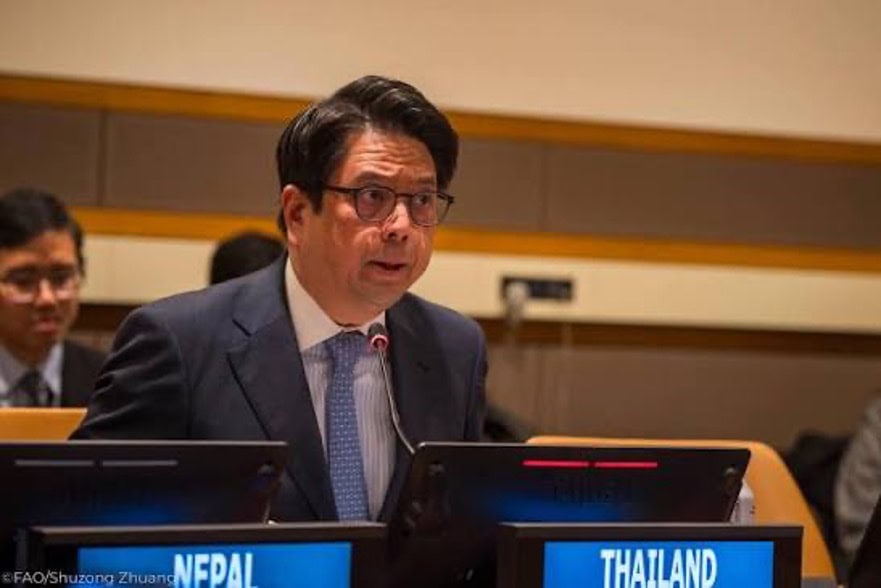
Recent comments by Thailand’s ambassador to the United Nations, Cherdchai Chaivaivid, about Cambodians living near the Cambodia–Thailand border deserve careful consideration. They should not become another trigger for political confrontation. Instead, they underline the need for both countries to return to the legal and bilateral mechanisms established to address their border issues.
During Thailand’s Right of Reply at the 81st session of the UN General Assembly on September 28, Ambassador Cherdchai said that the Cambodians described as internally displaced people were living in locations first established as temporary shelters in the 1970s. He characterised their continued presence as an encroachment on Thai territory. Thailand’s Permanent Mission also reiterated its preference for dialogue and diplomacy.
This leads to a basic question: if Thailand is certain that the areas are unquestionably within its territory, why not allow the Cambodia–Thailand Joint Boundary Commission (JBC) to complete its work using the agreed legal and technical procedures?
That is the constructive question both governments should answer.
The JBC should determine the answer, not unilateral claims
International borders should not be settled by political statements, military deployments, competing maps or public rhetoric. They should be determined through the treaties, agreements, technical procedures and recognised principles of international law that apply to both countries.
Cambodia has repeatedly urged the resumption of joint surveying and demarcation through the JBC. In September 2026, it again called for the commission to begin this work as soon as possible, citing existing bilateral agreements and the December 2025 Joint Statement. Cambodia says its position rests on the historical Franco-Siamese agreements, relevant maps and records, the 2000 Memorandum of Understanding, the 2003 Terms of Reference and other documents accepted by both sides.
Thailand has also acknowledged the JBC’s importance as a bilateral mechanism. At the sixth JBC meeting, held in Phnom Penh in June 2025, the two sides reached technical understandings on boundary pillars, joint surveys and the use of tools such as LiDAR and orthophoto mapping.
The sensible next step is therefore not an endless contest over which public statement is more persuasive. It is to allow the JBC to do its work.
Where the boundary’s location is disputed, technical experts from both countries should assess the evidence together. That evidence can include treaties, maps, boundary markers, historical records, survey results and other legally relevant material. Any conclusions should come through a process agreed by both governments.
Such an approach would be much more productive than allowing rival narratives to increase suspicion between two neighbouring populations.
International law should provide the common ground
Cambodia and Thailand are modern states, members of the United Nations and participants in ASEAN. Both have repeatedly declared their support for peaceful dispute settlement and respect for international law.
The border question should therefore be handled through legal instruments and agreed procedures, rather than unilateral declarations.
Cambodia has said that the land boundary should be considered in light of the relevant Franco-Siamese conventions and treaties, the maps and records linked to the historical delimitation process, and later bilateral agreements, including the 2000 MOU. It has also stressed the importance of preserving established frontiers and resolving disputes peacefully.
Thailand has its own interpretation of the territorial and security questions and has publicly maintained that some areas claimed by Cambodia fall within Thai territory. Such differences are precisely the reason bilateral mechanisms were created.
A dispute cannot be resolved by each side simply repeating its own position. It requires evidence, legal analysis, negotiation and mutually accepted technical procedures.
Dialogue must lead to sustained, practical work
The quality of bilateral dialogue is another central concern.
Cambodia has repeatedly called for border surveys and demarcation to resume through the JBC. Cambodian officials have said that diplomatic messages were sent proposing meetings and the deployment of joint survey teams. In June 2026, Cambodia’s State Secretariat of Border Affairs reported that several proposed activities had been postponed and urged the process to restart.
It is also important to recognise that contact has not entirely ceased. The two countries have held JBC discussions, and on September 29, 2026, the secretariats of their Regional Border Committees held an informal meeting under the observation of ASEAN Observer Teams.
The key issue is not merely whether officials meet. It is whether those meetings deliver measurable progress on the ground.
Meetings that do not result in implementation cannot create durable confidence. Both sides should ensure that the established mechanisms convene regularly, agreed technical work moves forward and disagreements are handled through direct communication rather than competing public narratives.
The humanitarian cost must remain central
Behind the arguments over maps, treaties and sovereignty are ordinary people.
Cambodian authorities have reported that approximately 20,000 Cambodian civilians remain displaced and cannot return to their homes in affected border areas. Other official Cambodian reports have identified communities whose return has allegedly been blocked by developments on the ground.
Whatever the two countries’ differing views on territorial status, the humanitarian concern should be shared. Families must not become permanent casualties of an unresolved boundary dispute.
One practical confidence-building measure would be for both governments to support the safe, voluntary and dignified return of displaced civilians wherever this is compatible with ceasefire arrangements, security conditions and applicable legal procedures.
The aim should be clear: once the necessary security and boundary arrangements are in place, people should be able to return safely to their homes.
Trust depends on action
Cambodia and Thailand cannot alter their geography. They will remain neighbours. The choice before them is what kind of relationship they want to build.
Thailand’s Permanent Mission to the UN has recently said that the two countries should pursue mutual confidence, peaceful coexistence and cooperation. Cambodia has likewise continued to advocate peaceful settlement through bilateral mechanisms and international law.
If Thailand maintains that Cambodian civilians are living on Thai territory, it should allow the JBC to carry out its mandate. If it wants to restore trust, it should participate fully in meetings and practical work with Cambodia. Trust will be built through implementation, not statements alone.