Peace Requires Respect for International Law, Not Just Promises
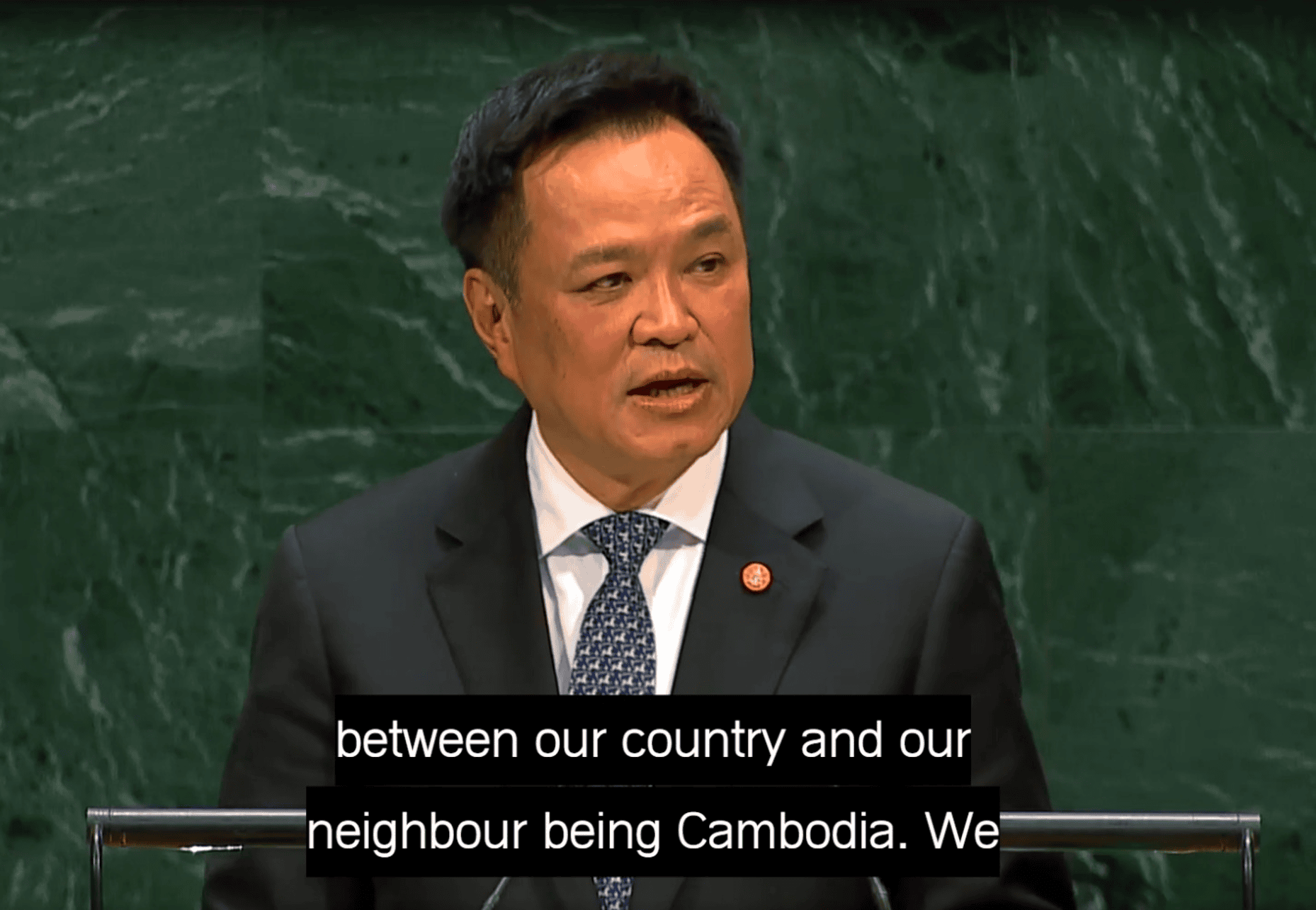
Prime Minister Anutin Charnvirakul told the 81st United Nations General Assembly on September 24 that Thailand had never sought conflict and urged Cambodia to make a sincere contribution to peace.
Any genuine appeal for peace should be welcomed. Cambodia has no interest in war. But durable peace requires more than diplomatic declarations. It depends on respect for sovereignty, international law, existing agreements, reliable evidence and the equal standing of all countries.
If Thailand is serious about peace, the two countries should address their differences through dialogue, impartial fact-finding and peaceful legal processes—not political or military pressure, or competing public narratives.
Online Crime and Territorial Sovereignty Are Different Questions
Thailand has every right to bring the serious issue of online scams and transnational crime before the international community. Cambodia should also cooperate in dismantling criminal networks, protecting victims and improving law-enforcement coordination across borders.
However, online crime and territorial sovereignty concern fundamentally different matters. The former involves transnational criminal activity; the latter involves borders, sovereignty, historical agreements, maps and international law. One subject should not be used to obscure or substitute for a proper examination of the other.
There should be no unsupported claim that Thailand is deliberately diverting attention from territorial questions. Intentions must be assessed through evidence rather than assumption. At the same time, international institutions have a duty to consider both issues independently and fairly.
Just as Thailand expects international bodies to hear its concerns about online crime, Cambodia should be given an equal opportunity to present its position on sovereignty and territorial integrity. Seeking that equal treatment is not an act of hostility toward Thailand; it is consistent with international law.
Peace Depends on Evidence and Impartial Review
Some countries are far removed from the Cambodian-Thai border and may not have a complete understanding of conditions there. Their views may be shaped by official statements, media coverage, historical records, maps and other material supplied by the parties.
International institutions should therefore assess relevant treaties, historical agreements, established legal decisions, independently verified information and the experiences of communities affected by the dispute.
No government should expect its account to be accepted without examination. Cambodia should likewise be willing to have its claims and conduct reviewed independently. International justice requires consideration of all pertinent evidence, regardless of which side provides it.
Peace Is a Responsibility Shared by Both Countries
The prime minister’s call for peace could give Cambodia and Thailand an opportunity to reinforce peaceful methods of resolving disputes. This should involve:
- Respect for international law and existing agreements
- Serious dialogue and restraint
- Independent confirmation of disputed facts
- Protection for civilians living near the border
- Appropriate bilateral and international dispute-resolution procedures
Peace should not be determined by military capability, economic weight or diplomatic influence. It should rest on rules that both sides accept and observe.
If Thailand has not sought conflict, as its prime minister said, that position should be reflected in actions that lower tensions and encourage peaceful solutions.
Cambodian and Thai Communities Deserve a Peaceful Future
Neither the Cambodian nor the Thai people need another war. Border communities on both sides deserve safety, dignity, economic opportunity and freedom from fear.
Governments may disagree about history, territory and the interpretation of law, but unresolved disputes between states should not turn ordinary Cambodians and Thais into enemies.
The two countries can cooperate against online crime while pursuing territorial questions through suitable diplomatic and legal channels. These obligations can be met at the same time.
The United Nations should hear both sides, review the evidence impartially and ensure that international law is applied equally to strong and less powerful states.
A Call for Peace Based on Justice
This is not a call for confrontation with Thailand. It is a call for truth, evidence, dialogue, accountability and respect for international law.
Respect for the Thai people should be matched by respect for the Cambodian people. Lasting peace cannot be built by avoiding difficult issues or allowing one concern to conceal another. If Thailand sincerely wants peace, Cambodia should welcome that intention—but it must be reflected in conduct as well as words.
Both countries should strengthen peaceful mechanisms, submit disputed facts to independent review and uphold sovereignty. Peace should not require silence. It should be grounded in justice, and justice begins with equal respect for international law.