Revisiting the Bas-Reliefs: Who Influenced Whom in Southeast Asia’s Water Festivals?
Each November, as Cambodia and Thailand prepare for their traditional water celebrations, the same question tends to resurface online and in public debate: did Cambodia borrow its water festivals from Thailand, or did Thailand inherit them from the older Khmer world? The author argues that a useful answer has to move past modern nationalist claims and rely on the earliest sources historians have, namely inscriptions, temple reliefs, and archaeological evidence.
The Evidence Carved in Stone
When it comes to Cambodia’s Bon Om Touk (Royal Water Festival) and Thailand’s Loy Krathong, the strongest evidence dates from long before either modern country’s borders took shape.
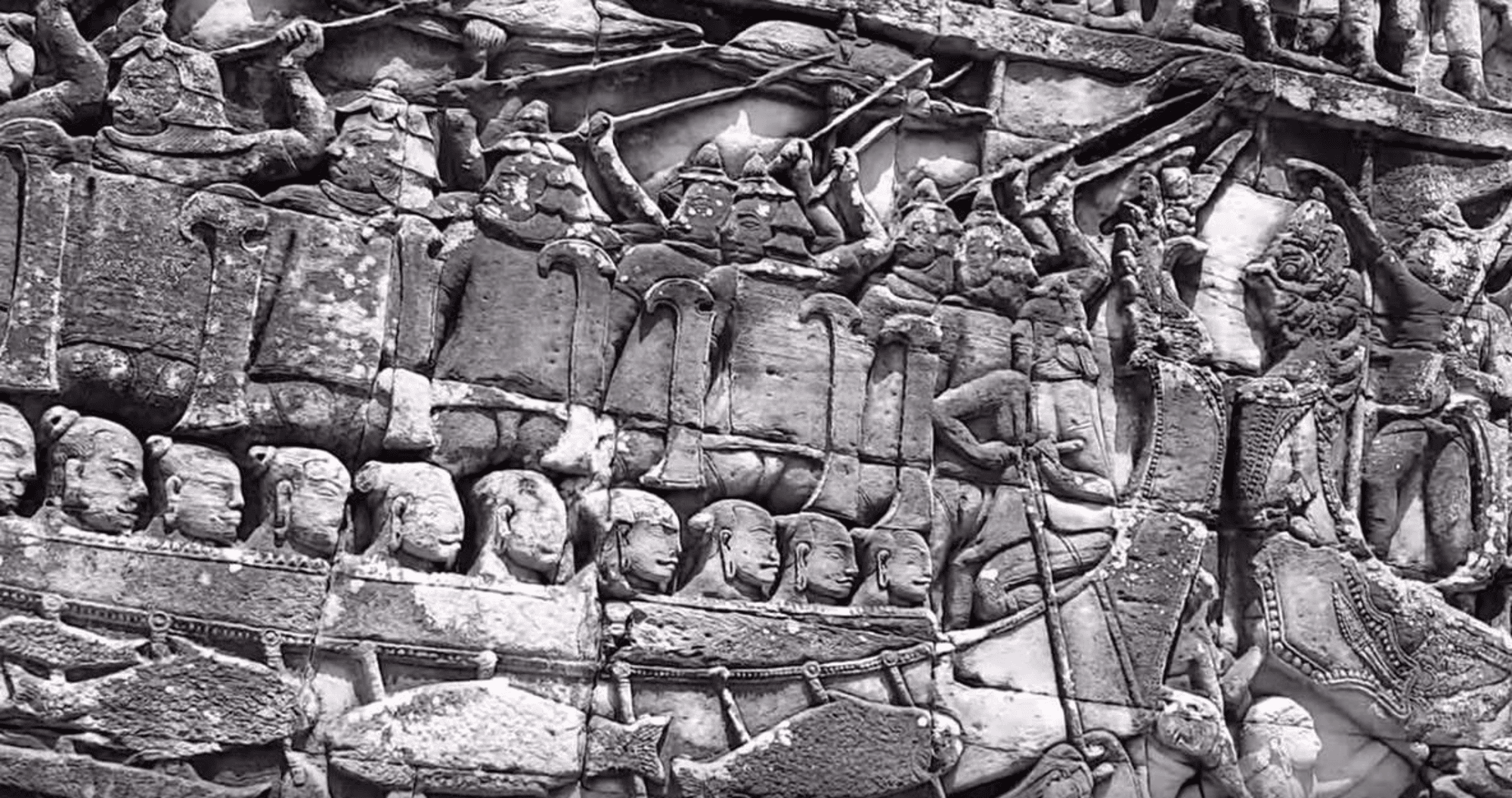
The bas-reliefs at Bayon and Banteay Chhmar, both built under King Jayavarman VII at the end of the twelfth century, show naval clashes on the Tonle Sap, long fleets of boats, coordinated rowing crews, military leaders, and rituals linked to the waterways. Scholars have widely read these scenes as records of Khmer naval battles and everyday river life in the Angkorian era.
The author stresses that these carvings matter well beyond military history. They show that water-based rituals, organised boat traditions, and river-focused state ceremonies were already firmly established in Khmer society centuries before the later Thai kingdoms emerged. In this view, the imagery is not folklore but archaeology.
Angkor’s rulers, in other words, had recorded their relationship with water in stone long before Ayutthaya rose to power, and even before Sukhothai became a major regional force.
The Khmer Empire and Its Water-Based Civilisation
To understand the origins of regional water festivals, we first need to understand the role water played in the Khmer Empire.
Angkor was built around one of the most advanced hydraulic networks of the pre-modern world. The Tonle Sap, its canals, reservoirs, and rivers supported farming, trade, transport, defence, and religious life. For the Khmer state, water was far more than a resource; it was the basis of political power.
The Tonle Sap River’s annual reversal of flow, rare anywhere else on Earth, became closely tied to seasonal celebrations, harvest cycles, and royal ceremonies.
Against this backdrop, Bon Om Touk grew into both a celebration of nature and a reminder of naval strength. The longboat races that remain central to the festival today, the author notes, carry forward practices that can be traced back to the Angkorian period.
Loy Krathong and Shared Regional Roots
Loy Krathong is now one of Southeast Asia’s best-known festivals, drawing millions of visitors each year. Its modern form developed within Thai society and is rightly valued as part of Thailand’s cultural heritage.
Still, scholars have long recognised that many mainland Southeast Asian water rituals have complex, interconnected origins. Various studies and cultural records point to Hindu-Buddhist influences that travelled through the Khmer cultural sphere and the wider Indianised states of the region.
According to some of the scholarship the author cites, floating-water ceremonies similar to Loy Krathong already existed during the Angkorian period, well before the Sukhothai-era accounts usually linked to the festival.
The author is careful to add that this does not mean modern Thailand ‘stole’ its traditions. Rather, it reflects how cultures have borrowed, adapted, and localised customs from their neighbours over the centuries.
Sangkranta Before Songkran
The April New Year celebration follows the same pattern. Known as Moha Sangkranta in Cambodia and Songkran in Thailand, the festival descends from the Sanskrit concept of Saṅkrānti, the sun’s entry into the zodiac sign of Aries.
These astronomical and religious practices reached mainland Southeast Asia through Indian influence many centuries ago and took deep root in the Khmer world.
As Tai-speaking peoples founded their own kingdoms in lands once under Khmer influence, they absorbed many existing religious, calendrical, and ceremonial customs. Thailand later turned Songkran into a celebration recognised around the globe, while Cambodia kept its own older version rooted in the same shared heritage.
So, Who Borrowed From Whom?
The historical record does not support the simple accusation that one modern nation copied the other.
If the question is which civilisation left the earliest physical evidence, however, the answer is clearer. The Angkorian Khmer left twelfth-century reliefs, inscriptions, and monumental architecture showing organised water ceremonies, naval traditions, and river-centred cultural life. These sources predate the later court traditions usually associated with the development of Thailand’s major water festivals.
It is therefore more accurate to say that many water traditions practised today across mainland Southeast Asia grew out of a shared cultural landscape, in which the Khmer Empire played a major and early role. The evidence suggests not that Cambodia copied Thailand, but that later kingdoms inherited and reshaped traditions that already existed in earlier civilisations.
Honouring History Without Rivalry
Recognising historical precedence should not be mistaken for hostility toward other cultures.
Bon Om Touk, Loy Krathong, Songkran, the Bun festivals of Laos, and the water celebrations of Myanmar are all part of Southeast Asia’s rich and layered heritage.
The goal of studying history is not to diminish any culture, but to understand where traditions came from, how they evolved, and what the surviving evidence actually shows. The bas-reliefs at Angkor, the author concludes, still tell their story in silence, and anyone willing to study the stones will find the record there.