Singapore Calls for a UN Framework Convention on AI Safety
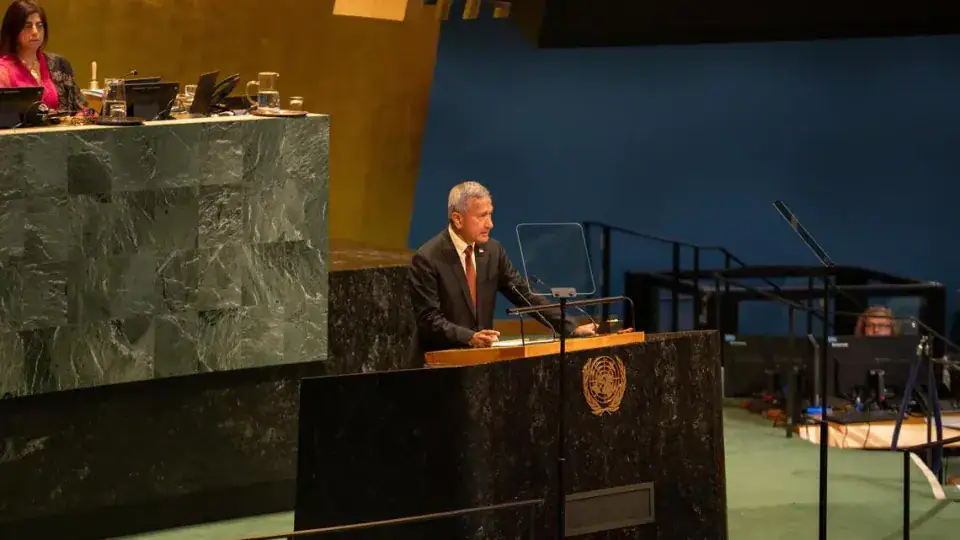
With the United States and China accelerating their artificial intelligence efforts, it is too late to call for a pause, Singapore’s foreign minister told the United Nations. The priority, Vivian Balakrishnan said, should be creating institutions that can develop safeguards and shared standards.
Speaking at the UN General Assembly’s annual debate in New York on Sept. 26, Balakrishnan urged countries to establish new rules for emerging technologies. He said governments should consider a UN Framework Convention on AI Safeguards, potentially a broad treaty setting out basic principles, cooperative institutions and a structure for international action.
Turkish President Recep Tayyip Erdogan also called for a common international legal framework for AI in his UN address.
Balakrishnan said an international body could carry out some of the technical-standard-setting work done in other fields by the International Telecommunication Union, which oversees global telecommunications and digital networks, and the International Atomic Energy Agency, which promotes the safe and peaceful use of nuclear technology.
He outlined three broad AI risks: losing control of autonomous systems; malicious actors using AI to develop biological or other weapons of mass destruction; and widespread political and social disruption.
But, he said, the technology’s rapid advance and the intense competition around it mean a halt is no longer realistic. The United States and China are beginning to explore dialogue, while companies have powerful financial incentives to develop frontier models.
Balakrishnan compared AI safeguards to the brakes and traffic rules needed to use a high-performance car safely. He called for rigorous testing before systems are deployed, clear boundaries on what autonomous systems may do, and ways to intervene when they act unexpectedly.
Because AI risks cross national borders, those safeguards must be understood and applied internationally, he said. Human beings must retain ultimate control, he added, asking whether people would want an AI to hold the nuclear launch button.
Any lasting global approach, Balakrishnan argued, must give every country a meaningful role—not just states with the most advanced models, greatest financial resources or largest arsenals.
Singapore has joined other efforts on the issue. Balakrishnan said the country had signed a call for stronger safety and security measures for frontier AI models. More than 20 countries and the European Union signed a declaration at the UN gathering, led by Finland and Norway, urging binding government oversight rather than reliance on companies’ voluntary self-regulation.
International cooperation should start now, he said. Rules, in his view, can give countries the confidence to advance AI more quickly and effectively for the benefit of their populations.
China’s drive to compete in AI
In a Sept. 25 discussion with Kevin Rudd, former Australian prime minister and head of the Asia Society, Balakrishnan discussed the US-China contest in AI. He said China views the race in historical terms and is determined not to miss another major technological shift after missing much of the Industrial Revolution.
Balakrishnan said China sees the moment as an opportunity to secure its place in the global economy and wants access to technology and a level playing field. Rudd noted that state subsidies are a significant part of China’s strategy. Balakrishnan agreed, but said subsidies alone do not account for the country’s progress.
China also has a strong scientific and technological base, he said, pointing to its advances in manufacturing, robotics, electric vehicles and renewable energy. Fierce competition among Chinese companies has also helped produce AI models that are both inexpensive and efficient.
The United States, meanwhile, retains an established advantage in turning technology into products, services and profitable companies, Balakrishnan said.
Why even powerful countries need partners
Balakrishnan’s UN speech also made a broader case for multilateral cooperation amid rising trade barriers, supply-chain disruption, climate change and technological upheaval. He warned that international relations are increasingly shaped by raw power, putting smaller countries such as Singapore at risk.
Powerful states also stand to lose, he said: military and economic strength alone cannot secure supply chains, protect people from pandemics or stabilise the climate. Even major powers need partners to protect their long-term interests.
The challenge, Balakrishnan said, is not deciding whether multilateralism is necessary, but making it effective. He called for consistent respect for international law and reform of existing global institutions. He also stressed the importance of protecting freedom of navigation and overflight to keep supply chains open, particularly amid the disruption to oil, gas and fertiliser shipments through the Strait of Hormuz caused by the Iran war.