Singapore Calls for UN Framework Convention to Govern AI Safety
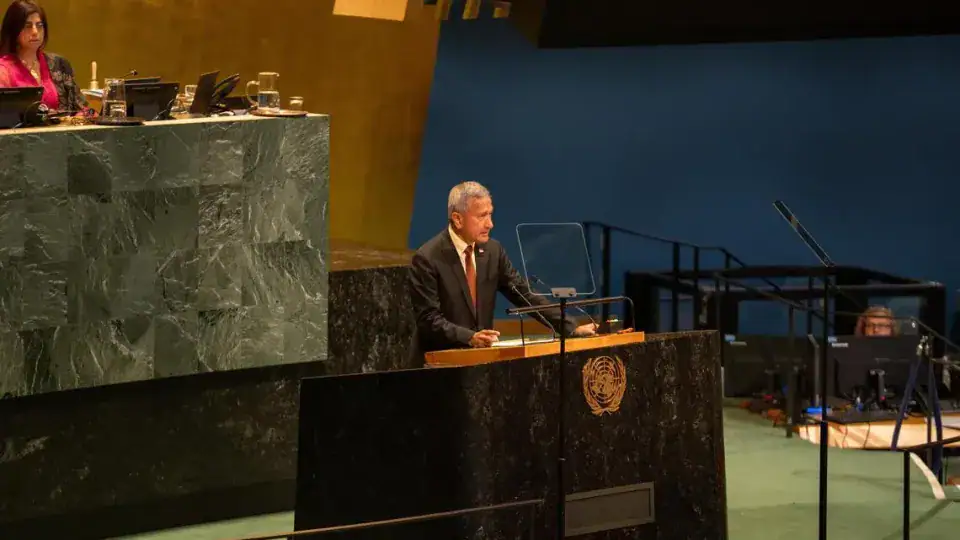
With the United States and China racing ahead in artificial intelligence development, calling for a pause is no longer realistic, but establishing institutions to create safeguards and standards would be valuable, Singapore's Foreign Minister Vivian Balakrishnan told the United Nations on September 26.
Speaking at the General Debate of the UN General Assembly in New York, Balakrishnan emphasized the need to develop fresh regulations and potentially create new institutions to address emerging technologies.
He proposed exploring the possibility of a UN Framework Convention on AI Safeguards—similar to the international climate change treaty—that would establish foundational principles, cooperative institutions, and a structure for coordinated global action. Turkish President Recep Tayyip Erdogan echoed this sentiment in his own address, calling for shared international legal standards for AI.
Need for International Standards
Balakrishnan pointed to growing concerns from technology leaders, safety researchers, and policymakers who warn that AI capabilities are outpacing humanity's ability to manage them safely. He suggested an international body could fulfill for AI the same standard-setting role that organizations like the International Telecommunications Union play for global communications networks, or that the International Atomic Energy Agency provides for nuclear technology.
The minister identified three primary risks: losing control over autonomous systems, malicious actors using AI to develop biological or mass-destruction weapons, and widespread political and economic disruption.
However, he acknowledged that the technology has already advanced beyond the point of stopping. Given the competition between major powers and the substantial financial stakes for companies developing cutting-edge AI models, halting progress is unrealistic.
Rules of the Road
Using the metaphor of high-performance vehicles, Balakrishnan explained that speed requires both a powerful engine and reliable brakes. Crossing boundaries safely demands shared rules, traffic signals, insurance, behavioral norms, and safety restraints.
He called for thorough testing and evaluation before deployment, clear boundaries on what autonomous systems can do, and intervention mechanisms when they behave unexpectedly. These safeguards must be universally understood, he said, since AI risks cross borders.
Fundamentally, humans must retain ultimate control. Balakrishnan posed a stark question: would anyone want an AI controlling nuclear weapons instead of a human?
Any lasting international framework must give all nations meaningful participation, not just those with the most advanced technology, deepest resources, or largest military arsenals. Singapore joined over 20 countries and the European Union in signing a declaration advocating for binding international governmental oversight of frontier AI models rather than relying on corporate self-regulation.
China's Historical Perspective
In a separate conversation with Kevin Rudd, former Australian prime minister now leading the Asia Society, Balakrishnan analyzed China's approach to the AI race. He explained that China views this competition through a historical lens: having missed the 20th-century industrial revolution and suffered what it considers a century of humiliation and unfair treaties, China is determined not to miss this technological wave.
While acknowledging China's extensive use of state subsidies, Balakrishnan noted this doesn't fully account for Chinese AI success. The country has developed strong scientific and technological foundations, surpassing Western nations in manufacturing, robotics adoption, electric vehicles, and renewable energy. Intense domestic competition among Chinese AI companies has also produced cost-effective and efficient models.
Multilateral Cooperation Essential
Balakrishnan's UN address also stressed the importance of multilateralism amid rising trade barriers, supply chain disruptions, climate change, and technological upheaval. He warned that international relations increasingly operate on raw power dynamics based on size, leverage, and coercion, threatening smaller nations like Singapore.
Yet even powerful states ultimately suffer without cooperation, he argued, since military strength alone cannot secure supply chains, protect against pandemics, or address climate change. Major powers need partnerships to secure their long-term interests.
The challenge is not whether multilateralism is necessary but how to make it effective. Balakrishnan called for consistent compliance with international law and reform of existing global institutions, particularly to maintain freedom of navigation crucial for protecting supply chains.