Twelfth-Century Engineering Feats: How Ancient China and Cambodia Bridged Vast Waters
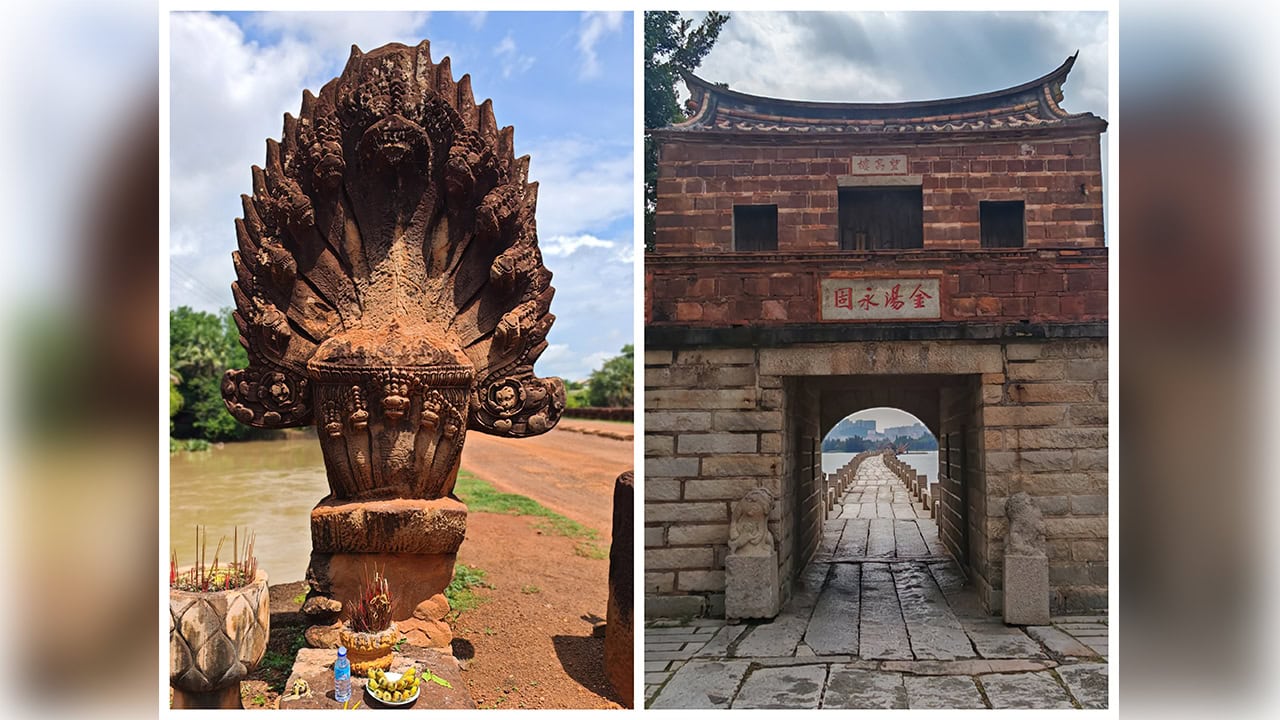
Nearly nine hundred years ago, builders in two distinct Asian civilizations independently devised sophisticated solutions to cross challenging waterways. In coastal China, laborers set mammoth granite slabs over a tidal estuary, while engineers in the Khmer Empire raised stone-arched spans across inland rivers. Today, China’s Anping Bridge and Cambodia’s Spean Praptos—widely known as Kampong Kdei Bridge—stand as extraordinary testaments to twelfth-century architectural ingenuity.
The Tidal Feat of Anping Bridge
Spanning an estuary between Anhai and Shuitou in Fujian province, Anping Bridge was constructed during the Southern Song dynasty between 1138 and 1152. Stretching approximately 2.25 kilometers with widths ranging from 2.9 to 4 meters, it is also referred to as the Five-Li Bridge, reflecting its length according to traditional Chinese measurements.
Constructing such a vast structure over soft seabed mud required ingenious techniques:
- Sleeper-log foundations: Builders laid timber rafts across the silt and weighed them down with heavy rocks, gradually driving the base down until it reached solid, weight-bearing ground.
- Tidal transport: Lacking mechanical cranes, workers floated massive granite beams into place by boat, relying on the rise and fall of coastal tides to position stones weighing up to 25 tonnes and measuring as long as 11 meters.
- Hydrodynamic piers: The bridge rests on roughly 360 piers sculpted into three distinct forms—rectangular, single-pointed, and double-pointed boat shapes—tailored to disperse currents of varying intensity.
- Natural reinforcement: Over time, colonies of oysters settled around the submerged masonry, their calcified shells naturally binding and protecting the stones against wave erosion.
Anping Bridge played an indispensable role in regional trade linked to Quanzhou’s bustling maritime port. In 2021, its historical significance was formally recognized when it was inscribed as part of a UNESCO World Heritage site.
Cambodia’s Monumental Laterite Arches
During roughly the same historical period, the Khmer Empire was executing its own ambitious infrastructure program under the reign of King Jayavarman VII. Situated in Siem Reap province’s Chi Kreng district, the Kampong Kdei Bridge formed a vital link in the royal highway network connecting the capital of Angkor with outlying regions.
Unlike the flat beam-and-pier design of Anping, Kampong Kdei extends around 87 meters and features more than twenty corbelled arches built entirely from laterite stone. Its balustrades are sculpted into nine-headed nagas, merging practical river-crossing engineering with the artistic and spiritual symbolism characteristic of classical Khmer monuments.
Contrasting Visions of Infrastructure
While differing dramatically in design and materials, both structures resolved comparable logistical hurdles. Anping Bridge conquered tidal forces to support coastal commerce, whereas Kampong Kdei spanned a river to maintain overland imperial communication. Centuries after their completion, both bridges remain enduring monuments to the technical prowess, economic vitality, and cultural vision of the medieval world.