Two 12th-Century Bridges That Tell Different Stories of Engineering
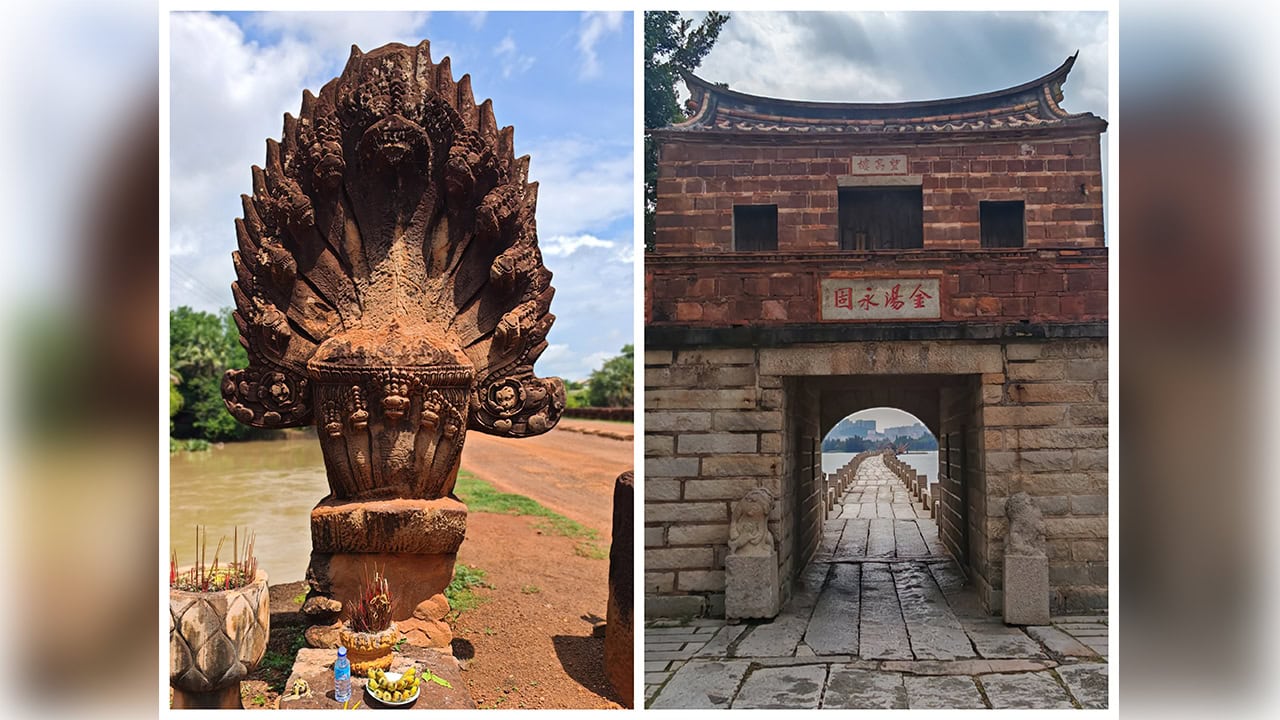
Contrasting solutions from the same era
Close to nine centuries ago, builders in southern China were setting heavy granite beams across a tidal waterway in Fujian, while Khmer craftsmen were creating arched stone crossings along the road system of the Angkorian Empire. Though the two projects addressed similar needs, they did so in very different settings: Anping Bridge and Spean Praptos, better known as Kampong Kdei Bridge, have both survived as evidence of sophisticated 12th-century design.
Anping Bridge: tides, timber, and massive stone
Anping Bridge joins Anhai town in Jinjiang with Shuitou town in Nan’an, both county-level areas under Quanzhou in Fujian. A guide speaking to a visiting group of ASEAN journalists on September 22 described how its builders dealt with a soft seabed, strong tidal flow, and the challenge of shifting blocks weighing several tonnes.
Work started in 1138 under the Southern Song dynasty and finished in 1152. That means construction began 888 years ago, and the completed bridge has been standing for roughly 874 years. The structure stretches about 2.25 kilometres and varies in width from 2.9 metres to 4 metres. Its name Wuli Bridge, or Five-Li Bridge, reflects its length of around five traditional Chinese li.
Among its largest stone slabs, the longest measures about 11 metres, and the heaviest is around 25 tonnes. With no modern lifting equipment, workers brought granite by boat and timed the raising and lowering of water to lift and place slabs onto piers. Some local traditions say stone came from Kinmen and nearby islands, but the exact origin of all the granite has not been proven.
One key method was the sleeper-log foundation. Timber was laid over soft mud, and heavy stones were placed on top, gradually pushing the base down until it reached firmer ground capable of bearing the load. Underwater, oysters helped protect the masonry. Rather than acting as a glue, as some accounts suggest, their shells built up around submerged stone and added a tough outer layer against wave action and erosion.
Builders shaped piers to suit water movement. The bridge uses three basic forms:
- rectangular piers
- single-pointed or half-boat-shaped piers
- double-pointed boat-shaped piers
Official descriptions typically list 360 piers, split into 290 rectangular, 44 single-pointed, and 26 double-pointed; other counts give 361. In all cases, there are 362 openings for water to pass through.
Anping Bridge was not only a crossing. It helped link Quanzhou with places farther south and supported maritime trade during the Song and Yuan periods. In 2021, it became one of 22 component sites in the UNESCO-listed Quanzhou: Emporium of the World in Song–Yuan China. Around it today, shaded lakeside trees remain a popular spot for older residents to sit and enjoy the view.
Kampong Kdei: laterite arches on an Angkorian road
Kampong Kdei Bridge offers a clear comparison. Located at Kampong Kdei in Chi Kreng district, Siem Reap province, the roughly 87-metre crossing is linked to King Jayavarman VII and the road network that joined Angkor to other regions of the Khmer Empire.
Unlike Anping’s long granite beams supported by hundreds of piers, Kampong Kdei was constructed from laterite blocks and features more than 20 corbelled arches. Its balustrades, carved as nine-headed nagas, blend practical engineering with religious symbolism and Khmer artistic identity.
What the two bridges show
Each structure answered similar problems with different tools. Anping supported a maritime trading system and depended on tidal movement, timber foundations, and piers adapted to currents. Kampong Kdei carried travellers across a river within the empire’s land routes.
That both survive suggests these ancient crossings were more than functional routes. They also expressed economic strength, technical knowledge, and cultural identity.